Nairn Post Office

From: Post Office <yourpostoffice@yourpostoffice.co.uk>
Sent: 30 July 2025 11:53
To: Chief Executive – HQ <chief.executive@highland.gov.uk>
Subject: Post Office Limited – Nairn – IV12 4QD

Post Office
Dear Mr Brown,
We have finalised our plans for the above Post Office.

To view our plans, please visit our Consultation Hub via the link below:

Consultation Hub – Nairn IV12 4QD

It would be helpful if you could share this link through your social media channels and with any local groups or organisations within the community to help our customers and your constituents understand what is happening.

Customer information materials will also be available in branch.
Yours sincerely

Audra Mirjah-Clarke
National Consultation Manager
Privacy Policy  |  Contact us  |  Consultation Hub  |  View in browser
This email is being sent as a service message. If you have previously opted out of
receiving marketing communications from Post Office that opt out remains in place.

Post Office Limited is registered in England and Wales number: 2154540
Registered Office: 100 Wood Street, London, EC2V 7ER

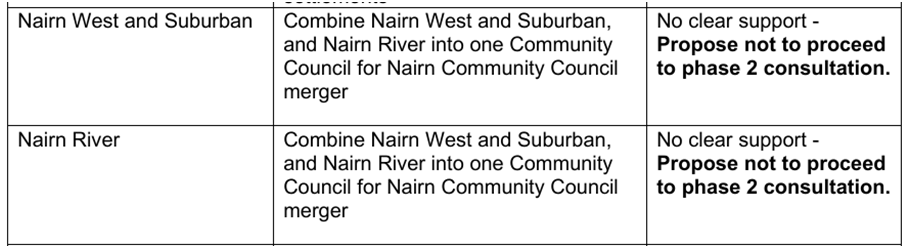
CC Merger Proposal is not to proceed to phase 2 SoE consultation.

At the Highland Council meeting on 15 May 2025 the “Review of the Highland Scheme of Establishment for Community Councils 2024/25 – Phase 1 Feedback” appeared on the agenda.

The most important item on the scheme for NRCC was the proposed forced merger of ‘NRCC’ and ‘Nairn West and Suburban CC’ to make one CC for the 10 000 plus residents of Nairn. The proposed CC would have been the biggest in the Highlands by far.

Neither NRCC nor NW&SCC were advised of this attempted nefarious act before THC had their ‘Special Meeting’ in December 2024 where the Council were presented with the Scheme Review. Many of our sister CCs, throughout the Highlands, submitted a comment that they were against this merger as being undemocratic and immoral.

NRCC and NW&SCC work closely together when any issues raised would have an effect on Nairn Town-wide, Tourism, Common Good matters and so forth but neither group were agreeable to the merger. CCs have no Authority over the Council nor over the local members but continuously suffer from those looking for someone to blame for the shortfalls Nairn suffers at the hands of the Highland Councils lack of funding for Nairn compared to smaller towns around the Highlands.

Dingwall

Dingwall 2

Caithness Thurso  

THC have “proposed not to proceed to phase 2 consultation” as there was “No clear support” or to put it another and probably a more correct way, they received many more comments against the proposal than were for the proposal.

Perhaps it is time for those who advocated a single CC for Nairn, including our own Provost, should now put their time and efforts, (especially that spent on facebook) in campaigning for the breakup of Highland Council. Nairn would have its own Council and be answerable to the People and not be governed by faceless officials in Inverness who are steadily building their own fiefdoms treating Nairn like their own latter day colony.

break-up-of-highland-council

snps-kate-forbes-says-highland-council-should be split

highland-council-is-a-prime example of centralisation

https://www.inverness-courier.co.uk/news/i-want-to-bring-back-local-democracy-to-nairn-it-is-long-o-368533/

one-size-fits-all-doesn-fit-work-call-for-highland-council to be broken up

Many Thanks to All the Community Councils in the Highlands that commented against the unwanted merger of NRCC & NW&SCC. It is good that CCs support each other in the face of THC beligerence or when poor planning or inferior developments threaten the well-being of a Community

Update from THC on the results of the the review on CC merger

“Not all questions were mandatory, did not require actual place of residency to be recorded and not every question was fully answered on all the submissions”.

“The total number of responses to the phase 1 Public consultation of the Community Council Scheme of Establishment across Highland was – 96, it is not possible to determine how many were residents from Nairnshire”.

“The total number of responses that indicated they wished to comment on the proposed boundary changes, Highland wide, was 75 and of those 38 indicated that they wished to comment on a change relating to a Nairnshire Community Council”.

“For the proposed merger of Nairn River and Nairn West & Suburban there were 35 responses that indicated that they wished to comment on the proposal, however, only 22 completed the comments question and of those 20 were against the proposal and 2 for the proposal”. – It is clear from this paragraph that the vast majority of those commenting on the Nairn CCs merger were against – a 10-1 ratio is a brilliant result for those who support two independent CCs in Nairn

“Given that the clear majority of those that did respond to the Boundary proposal were against it, it was agreed through the Report to Council not to proceed with the proposal in the 2nd phase of public consultation”.
Can we afford not to make integrated health & social care work in Scotland? – Alastair Noble

This contribution is in response to recent Reform Scotland articles. First, Sir Ewan Brown’s “Shifting the balance by £1 billion” and asking for those with detailed understanding of Health (and Social Care) budgets  to respond. It also builds on Dr Richard Simpson’s recent piece on structural reform including Health Boards and Quangos.

I have recently supported Nairnshire through our Community Led Local Place plan process and that fits well with Naomi Mason’s article “Can Community Wealth Building change the Conversation.” This takes us back to our natural Scottish model of the county town and its rural hinterland and in the cities – smaller natural groupings and support – the “Old Scottish Parish Model”

I have long argued that “the clinical decision is the purchasing decision”. All else has been simply a recording of that clinical decision.

Both Health and Social Care are service industries. We are there to serve our public and should deliver best clinical care in line with value for money and productivity.

This means local accountability and responsibility. We have the best data set in the world because of every patient’s registration with their GP and as we found with MAISOP ( Multi Agency Inspection of Services for Older People), we can allocate health and social care costs against each individual. This showed up very clearly the variations in clinical care in different localities with no obvious clinical reason for it. It was just “Aye Been”.

Simply put an elderly patient in one area was being well looked after at home, in another was in a nursing home and in another was in a consultant bed (often as delayed discharge) – all with the same medical condition – the difference was in what support package each locality chose to provide.

What could be worse than spending your last few months as a delayed discharge or an extra year or two in a nursing home – when you could have stayed in your own home with the correct care package.

The nearer you lived to a big teaching hospital -the more likely you were to be in it.

It is worth looking at these clinical variations first.

In Aberdeenshire over 60% of the OBD (Occupied Bed Day) for the over 75 population are in GP led Community Hospital beds. Glasgow had none.

In the UK, Torbay had prioritised “Mrs Smith and her home/Community care” and the figures contrast starkly again with Glasgow, which has followed the “Big Hospital Specialist Model.” Torbay had 18,000 OBD per 100,000 over 75, Glasgow has 72,000 OBD – four times as many!

Highland region has the highest delayed discharge rate in Scotland, with Raigmore Hospital losing over 3,500 acute bed days in November 2024 due to >75s “blocking” acute beds. Additionally, Raigmore has the highest re-admission rates in Scotland: 8.6% at seven days (compared to 5.4% nationally) and 14.5% at 28 days (compared to 11% nationally). Preventable admissions, particularly among the >75 population, where the average stay exceeds 40 days, could alleviate these pressures.

To put these figures into context NHS Scotland has around 6.4 million OBD

  • 0.8 million are scheduled/planned procedures -still with big variation in day care and outpatient investigation rates-but for another paper.
  • 5.6 million unscheduled/unplanned OBD
  • 600,000 OBD are delayed discharges = 2 District General Hospitals ( out of 20 approx. in Scotland including teaching and DGH as Specialist “Big Hospitals”.

Richard Simpson is quoting 1964 beds occupied by delayed discharges out of a total 13,700 beds.1 in every 7 beds blocked

  • 4 m OBD are by patients over 65
  • 2% of all patients occupy 79% of OBD
  • 2.5 % of all patients  = 50% of hospitals and prescribing total spend

Of the patients who are in hospital today 33.3% will be dead within 1 year and 1 in 10 will die in this hospital admission.

This year’s National Care of the Elderly Day of Care Audit (DOCA) again found that in these geriatrician led specialist beds over 60% of OBD (patients) would be better looked after in their own community/locality. Put bluntly they would have been receiving better and more appropriate care in their own community with an Integrated Community Care team. The geriatric bed complement being the biggest single specialty in medicine in terms of inpatient care.

To address these disparities, a holistic approach must be taken, one that emphasizes local solutions tailored to the needs of individual communities. Integrated Health and Social care can bridge these gaps by ensuring seamless transitions between services, thereby enhancing the quality of life for patients. Innovative models, such as increased investment in home-based care and community health initiatives, can prevent unnecessary hospitalizations and provide the right care at the right time.

Moreover, leveraging data analytics to monitor and evaluate care outcomes can guide policy decisions and resource allocation. By fostering collaboration between healthcare providers, social care services, and the community, we can create a responsive and adaptive system that truly serves the needs of our population. The goal should be proactive care rather than reactive measures, ultimately reducing the strain on hospitals and improving overall healthcare delivery in Scotland.

Over 65 unplanned admissions are biggest spend by far. Therefore, we start by concentrating on them. This builds on “The Perfect Equation, Perth & Kinross  98% work.” Which came out of the MAISOP visit and was built on by P&K to show difference in clinical activity and outcomes.

We need to model the changes that we must now commission per locality.

Fundamentals are to use locality-based data built on individual patient’s health and social care activity and spend. Per locality-in fact, each General Practice list combined up to a natural locality. Differentiate between GP led community/locality team care and Consultant led specialist team care.

The simple question will be ‘Which Bed Did You Sleep In Last Night?

This stops all “Cheating on Coding and Tarif”- the major failing in private and fund holding models.

This is why Cam Donaldson has long argued against “Privatisation” and in support of our current taxation based funding system. We certainly do not want the “American Model”. We need to prioritise patients being cared for in the bed/location that is best for them on any current day and we reallocate staff to where that patient care is best delivered for them as individuals.

DATA based on all patients on GP list over 65 OBD =100% of OBD

Level 1: at home (own house) no care package = 94 %( in best areas) –length of stay as long as needed, but under regular review ( This reflects how successful Health and Social Care are  at present). The “Golden Oldies” are looking after themselves well and we should be celebrating the success of Health and Social Care.

Level 2:  at home (own home) with complex care package =3% (in best areas) -length of stay as long as needed, but under regular review. This is where we must get staffing levels right. Good home helps are worth their weight in gold. Each locality should have its own “Integrated Community Team” and they should follow the patient and provide the necessary care wherever the patient is within the locality.

This fits well with the “Community Wealth Building “/Place Planning/Local Democracy Thinking. It is very beneficial for each community to have people living and working within their own community and contributing not just their economic wealth but also what good people contribute to each other in a viable and sustainable Model. This in particular will address the “Depopulation Worry” in many of our Rural districts.

Level 3:  in nursing/residential home with complex care package = 1% (in best areas) -length of stay should average out to about 1 year-outcome data driven-performance target. Again, the right local staffing is an essential component for this Model to work at its best.

Level 4: in community hospital bed (includes hospice, intermediate care, and step-down definitions).  No Delayed Discharges in Consultant beds. All non-consultant specialist beds with minimal DDs  =1% – length of stay should average out to about 14-21 days-outcome data driven-performance target

Level 5: in consultant specialist bed with agreement of GP and Consultant =less than 1% -length of stay should average out to about 7 days –outcome data driven-performance target. GP and Consultant should agree all admissions and after 7 days there should be a further clinical discussion and agreement before continuing Specialist treatment. This should be kept under regular review.

Again, the best of GPs and Consultants are in complete agreement about this. The patient should be getting the best of Consultant Care with minimal waiting times and once the benefits of that care are no longer clinically needed and  agreement reached they are transferred back to the Generalist Community team

We then can reduce  OBD x acute consultant level 5 tariff by 50%. Stress no delayed discharge at this tariff at this rate. Instant clinical discharge from level 5 to level 4 when clinically decided. This means real pressure on management to re-allocate staffing levels and costs.

We then can re allocate the money/resources/staff to the locality/community teams-again using OBD x tariff for levels 2-4.

Level 3  Again looking at reducing nursing home variation per locality from 3 to 1% for example.

Also reducing length of stay down to 1 year –better admission planning.

Level 2  Again look hard at optimum % rate

The locality should end up with as close to fixed locality staffing costs as possible using bench marking  for staffing levels 2-4.This model will also drive better capital costs -1 building as is being delivered in Nairn is a good example.

Additional work in progress

Look at admission rates per GP -identify the high admitters, poor copers. Then look at short length of stay – good consultants sorting out poor admissions. Then look at long length of stay – poor consultants and poor GPs not looking after individual patients properly. This will be very clear in bad /poorly performing localities.

One other very interesting and useful quality indicator is to record which bed did you die in for each locality?

Again, using the same 5 levels per locality:

Level 1 &2  -Own bed with or without complex care package =25%

Level 3 -Nursing Home bed= 25%

Level 4 – Community Hospital/Hospice bed = 30%

Level 5 – Specialist Consultant bed =20%

Both these indicators are much better than our existing waiting times and targets, especially as nobody can cheat or manipulate them.

I think this dynamizing around Which bed did You Sleep In? -OBD will drive the commissioning of good locality intermediate care faster than any other indicator.

So, what about money?

We must start with a “Fair Share Locality Budget” for each locality. This will include weighting for deprivation/rurality/age etc. This also prioritises local responsibility and accountability.

Using Sir Ewan projected budget of £20 billion for health this would equate to around £4,000 for health and about £1,000 for Social Care.

For example for Nairn this would be 16,000 patients x £5,000 = £80 million. Our current estimate is £14.2 million. A huge discrepancy.

We have chronically and deliberately underfunded “good community care” and equally deliberately over funded secondary care- “the Big Glasgow Hospital Model,” also found in Dundee (Ninewells and Aberdeen ARI). Various health Boards have traded in insolvency for many years and are just repeatedly bailed out.

This must not be allowed to continue. Health, as those of us who have worked in America know only too well, could swallow our entire spend. Corrupt coding and tariffs plus prolonged and unsuccessful /fruitless medical care is not a quality service.

We have clearly established that the variation in care practice within Scotland is not based on clinical need or indeed even the quality of clinical care as judged by outcome. It is just historic patterns and, in many ways, reminiscent of the “Old Demarcation Disputes “ which ended shipbuilding on the Clyde. They were still riveting when the Japanese were welding. This was aided and abetted by bad trade union behaviour but equally by bad management behaviour.

Care has moved on. The Health and Social Care systems have produced our fittest elderly population. I would love to see what £40-50 million a year spent in Nairn Healthcare would deliver, not just in health and social care ,but also in the sustainable wealth and happiness of our whole community.

If we re-allocate staff on the basis of this Occupied Bed Day x an agreed indicative national tariff, then moving, for example, all the OBD for Delayed Discharges would in effect move all these individual people to the best level of care for them and in practice make the staff available in the correct number and with the right training and support for all 5 levels of care.

The important difference would be that community and specialist care were treated similarly and fairly. The big benefit would be to all patients and their communities. All communities would benefit from this enhanced Community capacity including local spending power. Better functioning Communities throughout Scotland must be our goal.

We have all the data -clinical and financial we need to make this work. Now is the time for real reform based on our natural Scottish working unit – the “Old Scottish Parish” and our firm belief in “Community Empowerment” and the “Common Good” whilst making best practical use of our “Common Good Assets“ including our people and our irreplaceable Natural Environment.

We also need to restore faith in local democracy and our politicians at both local and national level. I think these reforms will help greatly in that renaissance.

If we let the voices of “doom and gloom” conquer, then we will have to find an alternative and I have not seen any evidence that we know what that will be. So, if we can simply start putting the patient first, their locality team as the priority, and right sizing secondary care this can be a win for all, and affordable within existing and even shrinking resource allocation.

A sensible Scottish solution based on the quality of our health and social care staff and above all best for each individual patient.

Dr Alastair Noble worked as a GP in Nairn and was awarded an MBE for his work in integrating Health and Social Care in Nairnshire Special thanks to all who have contributed over the years- Paul Leak, Campbell Mair, Gail Greig, Ken Crowden, Pete Knight ,Cam Donaldson, Sandy Strathearn, John Walker, Helen  Tucker, Helene Irvine, Joan Noble, Gerry Marr, Liz and Dannie Bow. The Scottish Association of Community Hospitals (SACH Alumni), CHA, Nairn Healthcare, MAISOP Team and Fergus Ewing for being a good MSP.

Post Office Limited – Nairn – IV12 4QD

We’re writing to let you know about some changes to the above Post Office.

For further information and to let us have your views, please visit our Consultation Hub via the link below:

Consultation Hub – Nairn IV12 4QD

It would be helpful if you could share this link through your social media channels and with any local groups or organisations within the community to help our customers and your constituents understand what is happening.

Customer information materials will also be available in branch.
Yours sincerely

Audra Mirjah-Clarke
National Consultation Manager

At the Corporate Resources Committee the Delivery Plan Budget Monitoring & Progress Update – Income Generation was presented.

The Delivery Plan 2024-27 consists of 64 projects/programmes, managed through 6 Portfolio Boards. With all these projects surely Nairn will be blessed with lots of Council investment and many revenue generating opportunities.

Lots of things have been going on at the successful Storr Centre on Skye which opened in July 2024 which is great.

Six other sites have currently been initially identified for the consideration of the expansion of visitor services. Glenmorven Associates Ltd, which undertook the Storr Centre feasibility study, has been appointed to prepare business cases for the following 4 sites:

• Smoo Cave, Sutherland, Ward 1

• Duncansby Head, Caithness, Ward 3

• Chanonry Point, Black Isle, Ward 9

• Torvean, Inverness, Ward 13.

So nothing for Nairn in this list as Nairn has not been chosen for any expansion of visitor services but bound to be something in the Tourism Schemes:

The Caravan and Motorhome Scheme target of £500 000 was missed last year and is forecasted to reach £20 000. Accept there is not much revenue there to spread around but..

Under the Dry Waste Scheme – see below – Nairn is to receive a new ‘reduced aperture Galvanised 1100 litre bin’ down at the Harbour – unfortunately Nairn will not be receiving an enclosure to go along with it… Still mustn’t grumble, don’t want to be seen as being ungrateful. After all the Council paid for the project at West Links, no wait… that was the Common Good and Team Hamish/NICE. Still the Council paid for the Splash Pad… Hold it was that not the Common Good and Team Hamish/NICE. Surely the Council pays for HLH to cut the grass and remove the leaves at the Links. Oh no sorry that’s the Common Good – twice.

Funding in the Highlands

A Simplistic view of some Funding for Areas in the Highlands

A Collation from several tables from Highland Council documentation that reflects possible funding for each of the areas in the Highlands

No matter how we looked at the data Nairn does not come out of this too well.

Allocated and Uncommited funds can be from Highland Communities Coastal Fund; Place Based Improvement Programme; UK Shared Prosperity Capital; UK Shared Prosperity Revenue. Figures are from documents received in 2024

Option 1 Strategic @ 15% Allocation – Option 2 Strategic @ 30% Allocation – Option 3 Strategic @ 50% Allocation –