As Chair of Nairn River Community Council, I find it disturbing that the planner on this case (25/04926/MSC Approval of matters specified in conditions of 24/03438/PIP) approved it herself at the delegated decision stage.
Community Councils are statutory consultees on planning applications. Their role is to monitor applications to ensure they follow the current National Planning Framework policies, where possible, and comment as appropriate. They should also gather their community’s views on planning matters and reflect those views in application responses when they align with the National Planning Framework. These applications are in breach of NPF4 (as outlined below by the Highland Councils Forestry team) NRCC commented accordingly.
The planner appears to have disregarded both the Highland Council’s South Planning Committee (SPAC) decision and the objection from the Council’s Forestry Team. The Matters Specified in Conditions (MSC) application was intended to approve details under the Planning in Principle (PIP) consent, but instead ignored the conditions set out in that consent. In effect, a Highland Council official overruled a decision made by elected councillors, including the two Nairnshire councillors on SPAC. The PIP approved by SPAC required all retained trees identified in the approved Tree Protection Plan to be protected. However, the MSC removed many of the tree-retention and protection measures imposed by SPAC. As a result, many “trees of high biodiversity value” have been lost, including rare and distinctive specimens. The developer was also found to be in breach of planning permission within the first few days of operation by removing a tree or trees that were to remain.
The Forestry Teams objection is reproduced below.
The Forestry Teams Consultation Response dated 27/02/26 to Ref 25/04926/MSC
POSITION We object to the proposed development, pending further information.
CONCLUSION The applicant has provided a layout which does not follow the indicative layout which we accepted in the PIP application and would result in a much greater adverse impact on trees. The proposals do not accord with National Planning Framework 4 Policy:
6 a) as they do not enhance, expand or improve woodland and tree cover.
6 b) ii as they would result in adverse impacts on native individual trees of high biodiversity value.
The proposals do not accord with policy 51 of the HwLDP as they do not promote significant protection to existing trees and woodlands on the site. We (Highland Council Forestry Team) therefore object to the application.
The planner did not appear to give sufficient weight to these issues, despite the Forestry Team being statutory consultees. A member of the Forestry Team recently stated that the land had greater ecological value than the whole of Tradespark Woods and should have been retained in its existing state. National Planning Framework 4 differs from previous frameworks because it now forms part of the statutory development plan. As a result, its policies should carry greater weight in day-to-day planning decisions. Green space also delivers significant environmental, health, and well-being benefits.
Where SPAC, as a committee of the Council under the Scheme of Delegation, consents a development—whether as Planning Permission in Principle (PIP), a full application (FUL), or Matters Specified in Conditions (MSC)—and imposes detailed conditions, Council members are entitled to expect Planning Officers to ensure those conditions are implemented. Otherwise, the purpose of Planning Applications Committees is undermined. Planning Officers are also required to read National Planning Framework 4 policies as a whole, rather than interpreting them selectively, as set out in the Chief Planner’s letter dated 26 June 2024. The fact that the MSC did not carry forward the PIP conditions, and failed to support the Forestry Team’s robust objection, indicates that the planner did not follow that guidance. The Forestry Team’s objection appears to have been disregarded entirely. As THC Forestry were consultees, the application should have been presented to SPAC, but the planner did not take that step.
It is concerning that, on 27 July 2026, the Area Planning Manager was unaware that application 25/04926/MSC had already been determined by delegated decision, with the decision issued on Monday 22 June 2026. The application was not presented to SPAC, despite the conditions imposed being far less robust than those required by SPAC for the preceding 24/03438/PIP application. As the Forestry Team were statutory consultees, the application should have been referred to SPAC rather than determined by a single planner under delegated powers.
Nairn River CC regrets the loss of this woodland at the eastern approaches to the Town. NRCC will continue to press for a new Industrial Estate to provide small, medium and large industrial and commercial units along with educational and training units at the Granny Barbour Industrial Estate as per the findings of the Community led Local Place Plan. Highland Council should honour the will of the that document and support this development by providing land allocation, financial and the capacity to deliver this undertaking.
There appears to be a troubling lack of openness and transparency in decision-making across the Highlands and Scotland. The recent taxi licence application, which was considered in private, and the forthcoming full Council meeting to review that decision, which is also expected to be held behind closed doors, are clear examples. It is difficult to see how such processes demonstrate openness or transparency
While we have taken every effort to present accurate information for your consideration, we cannot accept any responsibility for unintentional errors or omissions and you should satisfy yourselves on any facts.
Please read the below from Robin McAlpine
Fighting back against the ruling class’s reign of terror
by Robin McAlpine | 29 Jul 2026.
Another milestone approaches in the battle against Scotland’s unelected ruling class, and this one is a landmark. A judicial review is going to examine whether they can do whatever they want all the time – or whether natural justice matters.
Scotland’s ruling classes have fucked up. I mean really fucked up. After two decades of their unchallenged tyranny the outcome is collapsing universities, collapsing arts infrastructure, collapsing public services, a housing crisis, a domestic economy ownership crisis…
And what do ruling classes do when they fail? They crack down on those who seek to expose them. We, the ruled, can only defeat them by standing in solidarity, and a key moment with a chance to show some solidarity will happen next week. It also marks a legal milestone.
It is the latest show trial of Glasgow Councillor Fiona Higgins who, as a super-fast summary, has been persecuted for a year and a half for correctly identifying that a senior officer was hiding crucial information that should never have been hid and which his own colleagues said he shouldn’t have hid.
(I have been following this case closely because Fiona is proving to be a case study in the dogged determination not to be terrorised and silenced by the ruling classes. If you need a full catch-up, the basics of the case are explained here and then the developments that take us to next week are explained here.)
The only-slightly-longer summary is that Glasgow City Council’s Director of Finance removed from a draft budget document clear statements that the budget about to be approved required a reduction in teacher numbers, did so against the strong explicit objection of the Director of Education and by doing so left councillors passing a budget which was against their own policy because they were prevented from knowing they’d just voted to cut teacher numbers.
Fiona gets curious about this and asks for information. They refuse to give her the information so she uses the Freedom of Information Act to force the information out of them which reveals all of the above and the fact that his own colleagues objected to what he was doing. She pursued that internally, but no-one would take any action.
And this is what you really need to know – if a council official does this, the rules are that no action can be taken against them by any elected figure, but if the elected figure tells anyone what they’ve found, the unelected council official can take action against them.
If you’re new to this, I need to repeat it. If you vote for someone to represent you on a council and that person discovers an official is lying, the only thing they are allowed to do is to report it to the official’s boss. If the boss decides to do nothing, that is the end of it. If the councillor then tells anyone about this, the councillor is disciplined.
Why? Because the rules forbid elected representatives from criticising unelected officials in any way or form in public. Officials can lie without consequence but you can’t expose them without being open to being suspended. Oh, and that might make sense if the elected officials can sanction or remove the unelected official, but that’s banned too.
These officials who have no legitimacy whatsoever other than their role as servants to democratically-elected bodies have built themselves a system in which they can terrorise anyone who attempts to hold them to account
Another thing you should know; at about the same time as this, the official concerned and the boss who is the only person anywhere that can hold him to account were having private meetings to arrange lucrative ‘golden goodbye’ payments for each other that they were not entitled to, which were not approved through the required official channels and which led to Audit Scotland ruling that the officials “fell short of the behaviour and standards expected of public servants”.
So you as a member of public can only find out about dishonest practice if the person’s boss, who is in a co-dependent grift relationship with the person responsible for the dishonesty, agrees to do something about it (which in this case she did not).
Hence the ongoing pursuit of Fiona in a form of extended punishment. So, you might think, over to the public. I mean, the council can’t actually discipline the public, can they? Well it turns out they can if the lawyer the public picks screws up. You may have separately heard that the council are trying to bankrupt a group of mothers who challenged them in court.
Because it’s exactly the same case. After Fiona revealed what was happening, they took court action because they thought this was malfeasance. I won’t go into this but the case fell apart not because of the case itself but because of procedural error which was nothing to do with the plaintiffs. Yet as soon as the case fell apart, the council started its pursuit of the mothers involved. At one point the group of Glasgow mums involved turned up at a meeting to be faced with seven council lawyers, all paid for by Glasgow residents, not the officials.
Hence Leanne McGuire is being hounded by Glasgow City Council for legal costs of £43,000. Please do not mistake what is actually happening here. Scotland’s ruling classes are riven with corruption. I really mean that. They run a system where all-but set their own pay, invent bonuses for themselves, and give contracts to companies and then get even more lucrative employment with those companies.
Our media generally doesn’t catch them, simply because our media is so emaciated that the journalists who used to cover institutions like local authorities or the quango agencies no longer exist. Every so often someone else blows the whistle (like the instance with the Water Industry Commission Scotland) and this all comes to light. But it is rare.
And it is made rarer because of this reign of terror. That is the only word for it. These officials who have no legitimacy whatsoever other than their role as servants to democratically-elected bodies have built themselves a system in which they can terrorise anyone who attempts to hold them to account.
Look at what is happening in the universities. The unelected executive of Edinburgh University has just told the Senate that it is effectively unilaterally suspending the constitution of the university and is going to directly appoint people to roles who should constitutionally be selected by the Senate (which in turn is elected from the academic body).
Those hand-picked officials are to be put in place to force through a massive cuts process which is being run by the executive on its own without consultation because the executive left the university in a financially perilous condition.
Let me spell that out – the Standards Commission is arguing that it can run unjust kangaroo courts using public money and it can do so in any way it wants
They are utterly out of control. It is quite scary. If this was being done by a politician like Victor Orban you’d call it what it is – dangerous authoritarianism. He too put pliant figures in posts that others should have been filling and used those people to bypass law and the constitution. He too used judicial intimidation of the public. He too put critics on show trials.
Make no mistake, Fiona has financial and legal backing now and is taking the Standards Commission to court whether they like it or not (they definitely don’t like it). Which brings us up to speed. Next Tuesday sees Fiona’s judicial review (10AM, Court of Session) of the attempt by the Standards Commission to ‘sentence’ her while refusing to accept any of her evidence.
The Standards Commission’s defence is that it is allowed to run its own affairs however it wants and that does not need to mean fair or just treatment of the people it pursues. It is arguing that it is not obliged to operate by the standard rules of natural justice because there is an opportunity for appeal.
Let me spell that out – the Standards Commission is arguing that it can run unjust kangaroo courts using public money and it can do so in any way it wants because once it has completed the person suspended can use part of their £26k salary to hire a lawyer and appeal the decision in the Sheriff Court.
Legal figures are calling this a landmark case because if Fiona wins it will set the precedent that no, Scotland’s ruling classes cannot do whatever the fuck they want whenever they want all the time and that basic rules of natural justice apply. If it surprises you that this precedent has to be set in Scotland in 2026 then you are not alone.
The ruling class can lie but elected politicians can’t expose them. If the elected politician does expose them they can be sent to a ‘court’ which does not recognise the principle of natural justice. It can then suspend you and all you can do is try and find the money to get lawyers to go through the slow process of appeal.
Meanwhile the ruling class can also use unlimited public money – your money – to try and destroy the lives of the people they serve if those people try and hold the ruling class to account for the same malfeasance.
I want to make this as clear as I can – Fiona is making big sacrifices to stand up to the injustice of Scotland’s ruling elite and they are determined to defeat her. She is not standing up for herself, she is standing up for your right to live in a country that vaguely sounds like a democracy. I urge you to show her your support.
UPDATE 04/08/2026
Articles on todays hearing at Court from The Herald and The Glasgow Times
From the Glasgow Times
Judge told of ‘possible conspiracy to hide teacher cuts’ in Glasgow
By James Mulholland
A lawyer has told a judge that internal council emails and budget papers disclosed a possible “conspiracy” to conceal planned reductions in teacher numbers in Scotland’s largest local authority.
Advocate Dan Byrne KC told Lord Sandison on Tuesday of how the documentation from Glasgow City Council showed a potential cover-up at the public body.
The Court of Session heard from Mr Byrne as he spoke on behalf of his client, Councillor Fiona Higgins, at a judicial review brought by the elected representative.
Ms Higgins has brought an action to Scotland’s highest civil court against the ethics watchdog, the Standards Commission for Scotland.
It comes after Ms Higgins made public comments about proposals by Glasgow City Council to cut hundreds of teaching posts.
The former teacher claimed the public had been misled over the plans, but her comments led to a complaint by former council finance chief Martin Booth.
The complaint made to the commission claimed the post was “disrespectful, discourteous and public criticism of a council officer”.
She faces forthcoming proceedings before the watchdog over the comments which were made on the social media network X.
Ms Higgins has instructed Mr Byrne over how the Standards Commission has handled evidence in her case, which she says justifies her public comments.
The Commission refused to allow some of the documentation relating to the planned cuts to teaching numbers. It said the documentation was “irrelevant” to the complaint which has been made to it.
Ms Higgins believes this breaches article 10 of the European Convention on Human Rights – freedom of expression. She also believes the refusal to include the documents results in her being denied a fair hearing by Public Standards Scotland.
The action is being funded by businessman and musician Paul McManus, the drummer for Scots rock band Gun.
On Tuesday, Mr Byrne told Lord Sandison that the emails excluded by the watchdog may show evidence of a potential cover-up.
He also described a budget document as being the “smoking gun” and that Councillor Higgins was entitled to make the comments about the public being misled.
Mr Byrne said: “You’ve got the conspiracy in emails and you’ve got the smoking gun in the budget, put the two together and see what has really gone on and ask yourself is the public interest engaged by the tweet?
“Is this trivial – is this about paperclips being misallocated, or is there something more significant – if it’s paperclips, then the tweet goes a bit far. If it’s something more significant, then maybe it’s exactly where it wants to be in tone and content, and the public should be aware of its content and should be engaged in a discussion about an investigation.
“It also shows that there is a sufficiency of evidence behind it. There is a lot of material here which shows the conspiracy and the smoking gun.
“There is a lot of material available to justify the tweets.”
Mr Byrne’s submission is asking the court to overturn preliminary decisions made by the standards commission in February this year to exclude a series of emails, budget papers and other documents from the disciplinary hearing.
Mr Byrne told the court that the material raised questions which needed investigated and that his client was justified to bring the issues to the public’s attention.
He told the court that the documents could support Councillor Higgins’s viewpoint.
He added: “If we were before the commission tomorrow, these would form the centrepiece of our article 10 defence – these demonstrate something very significant and sinister in which there is a great public interest which actually cannot be divined from one short email.”
He said the documents could support the councillor’s public statements about proposed reductions in teacher numbers and were therefore central to her defence.
He added: “What they are really doing is cutting teacher numbers, the reality is they are cutting teacher numbers, and it’s quite clear from that correspondence that that fact is being withheld deliberately through the budget.”
Mr Byrne said the correspondence suggested officials were concerned that elected members might not fully understand the practical effect of the proposals.
Mr Byrne said one possible interpretation of the emails was that the proposals had implications for Scottish Government funding linked to the maintenance of teacher numbers.
He said: “Was it to secure funding from the Scottish Government to which it was not entitled?”
Mr Byrne said the documentation raised the need to have matters fully investigated.
He added: “Those aren’t positions that we firmly adopt. We call for an inquiry to get into whether those concerns might be well-founded.”
From The Herald
Councillor wins legal breakthrough in Standards Commission row
By Martin Williams
Financial/Business Journalist of the Year
Anger has erupted at the heart of Scotland’s political watchdog after a judge sanctioned a courtroom showdown over claims a councillor was effectively gagged for speaking out.
Glasgow Labour councillor Fiona Higgins has landed a dramatic legal breakthrough after winning permission to take on the Standards Commission for Scotland at the Court of Session — in a case now shaping up as a bruising test of free speech inside public life.
The explosive row stems from Glasgow City Council, where Ms Higgins was hauled before ethics chiefs after accusing senior officials of misleading elected members over plans to axe up to 450 teaching posts. Her intervention — broadcast on social media — triggered claims she had breached the councillors’ code of conduct.
The complaint was made by former Glasgow City Council finance chief Martin Booth after she publicly criticised the handling of proposed education cuts and made accusations that the councillors and the public were being misled.
But in a move her lawyers say strikes at the heart of natural justice, the Standards Commission refused to allow key evidence to be heard in her defence — dismissing it as “irrelevant”. Ms Higgins’ legal team hit back by launching judicial review proceedings, arguing she was being denied a fair hearing.
Now, in what Ms Higgins’s legal team say Lord Sandison has ruled her case has a reasonable prospect of success — paving the way for a full-scale legal battle that could expose how Scotland’s ethics system deals with dissenting voices.
The ruling has electrified critics of what they describe as a “closed shop” culture at the top of Scotland’s public bodies — and raised the stakes dramatically for the Standards Commission, which now faces the prospect of having its procedures picked apart in open court.
At the heart of the storm is a stark accusation: that a body set up to uphold standards in public life may itself have overstepped the mark. Ms Higgins’ legal team insist the refusal to admit crucial evidence was not just a procedural call, but a decision that potentially undermines the integrity of the entire process.
Her solicitor advocate, Professor Peter Watson, made clear the fight is about more than technicalities. The excluded material, he argues, goes directly to the substance of the allegations Ms Higgins faces and without it, any hearing risks being fundamentally one-sided. “These productions are clearly relevant,” he said. “To deny their inclusion is to deny a fair opportunity to answer the case.”
When the commission refused to budge, Ms Higgins’ team escalated the battle to Scotland’s highest civil court. Judicial review – a legal mechanism designed to hold public bodies to account – is not granted lightly. The court must be satisfied there is a real prospect of success and that no other route to justice exists.
At last week’s permission hearing, senior counsel for Ms Higgins argued the commission’s stance was not only wrong, but unlawful. In granting permission, Ms Higgins’ team say Lord Sandison accepted there was an arguable case that the watchdog had acted beyond its powers.
Legal insiders say the significance should not be underestimated. A successful challenge could force a rethink of how the Standards Commission conducts hearings, particularly in cases where elected representatives claim they are being punished for raising concerns in the public interest.
For Ms Higgins the situation is an emblematic of a wider problem. A former teacher who worked in one of Glasgow’s most deprived communities, she has framed the dispute as a fight for fairness, not just for politicians, but for the people they represent.
The backdrop to Ms Higgins’ intervention is a hugely contentious budget debate, in which proposals to cut hundreds of teaching posts sparked anger across the city. Critics warned of devastating consequences for pupils, particularly in disadvantaged areas.
It was in that charged atmosphere that Ms Higgins went public with her claims – alleging that councillors and the public had been misled about the nature and impact of the proposals. The response was swift and severe: a complaint was lodged with the Ethical Standards Commissioner, triggering the process that has now spiralled into a landmark legal fight.
The involvement of businessman Paul McManus has added another layer of intrigue. A multi-millionaire entrepreneur, Labour donor and drummer with Scottish rock band GUN, McManus is footing the bill for Ms Higgins’ legal challenge.
Without that backing, she argues, the case would never have made it to court.
“The reality is that many councillors simply cannot afford to challenge decisions like this,” Ms Higgins said. “That effectively puts justice out of reach.”
She added: “I’m pleased that the Court of Session has allowed my case to go forward.”
Mr McManus himself has been scathing about what he sees as an abuse of power. Framing the dispute in stark terms, he said the case goes to the core of fundamental rights — including freedom of expression under Article 10.
“The irony is this is about free speech,” he said. “Yet the system appears to be preventing her from even putting forward the evidence she needs to defend herself.”
He went further, accusing public authorities of “trying to crush individuals” — a claim that will only intensify scrutiny as the case moves forward.
The commission has yet to publicly respond in detail to the latest development, but it is expected to robustly defend its position when the case reaches a full hearing. Insiders suggest it will argue that decisions on admissibility of evidence fall squarely within its remit — and that its processes are both lawful and proportionate.
However, the optics are already proving difficult.
The image of a councillor forced to go to Scotland’s highest civil court simply to have evidence considered is one that critics say will resonate far beyond this individual case. Transparency campaigners argue it reinforces long-standing concerns about how power is exercised behind closed doors.
The full judicial review will examine whether the Standards Commission acted lawfully in excluding the disputed material — and, crucially, whether its approach breached basic principles of fairness. Depending on the outcome, the ramifications could extend well beyond Higgins’ own situation.
A ruling in her favour could open the door to further challenges from councillors who believe they have been treated unfairly — and force changes to how hearings are conducted in future.
A defeat, on the other hand, would strengthen the commission’s hand and reinforce its authority to control proceedings as it sees fit.


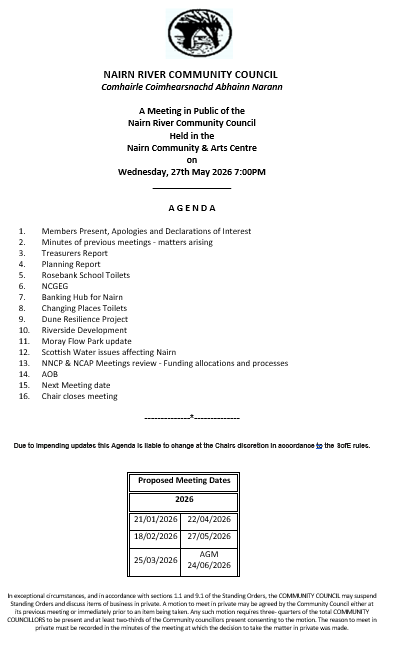



 Nairn River Community Council