By the time that Nairn River Community Council meets next Wednesday night in public the Nairnshire ‘Local Area’ Committee ( Nairn’s 4 Highland Councillors) will have made some big decisions affecting Nairn and Cawdor Ward at their quarterly meeting. The agenda published on the Highland Council website a week ahead of this meeting is below
In addition to reviewing regular reports from Housing and Police, plus the Winter Maintenance Plan we want to draw your attention to three key items of public interest which are about to be decided upon by Nairn’s 4 Highland Councillors.
This report presented by David Haas, Inverness City Area Manager, reveals
a balance of £681,861 usable reserves in the Nairn Common Good fund
a deficit in lettings income of around £12,000 by the year end ( chiefly due to cancellation of Nairn Games ) contributing to a reduced annual surplus of around £35,000
of this it is proposed to allocate £15,000 to annual running costs of the new Splashpad
Councillors are asked as CG Trustees to ‘homologate’ (retrospectively approve) waiving
£ 9464 fees for the Nairn Showies this August (a decision made with no reference to the people of Nairn), and unforeseen spending of around £1800 for removable of dead trees, a vermin cull (Viewfield), repairs to Links Flagpole and Harbour Street toilets.
The rest of the report deals with a condition report for Harbour Street toilets and costings of £12,500 for reinstatement and reopening for remaining 7 weeks of 2021 before winter shut down and future running costs for 2022 (£31,000)
The proposal on the table is to defer a decision on repairing and reopening Harbour Street toilets till early 2022 and ‘save’ £12,000 of Nairn Common Good funds by not reopening them before winter. This makes a key assumption that all costs of repairing and running these toilets ( built on CG land without due legal process by Highland Regional Council and maintained by them for decades) should be met by Nairn Common Good Fund, using almost the entire annual ‘surplus’. Whoever pays, is this a prudent investment, when years of neglect by the Council have left these loos in such disrepair, in a location now highly prone to flooding?
This is all the more surprising in a context where £2.4 million Visitor Management funding has already been spent across Highland this year ( everywhere it seems except Nairn) on improving public toilet facilities, with another £1.5 million available for next year. Here in Nairn the only spending from the Visitor Management fund we have seen has been £25,000 on controversial ‘Charging Infrastructure’ for 3 Common Good car parks.
At Nairn River our reading of the Community Empowerment Act makes clear that neither public toilets not parking arrangements on Nairn Common Good Land are appropriate matters for Highland Councillors or Officers to decide on in private.
Any changes or investment of public funds under consideration in these locations should be open for public consultation, before costly decisions are made, to ensure that all our CG Assets are properly utilised and maintained for the benefit of the people of Nairn and future generations.
In summary Highland Council have looked at the consultation responses from 98 members of the public, 3 completely in favour, 10 with mixed views and the other 85 completely against disposal of Sandown Lands at this time, including Nairn’s two ‘burgh’ community councils, and decided that after such a clear NO from the Nairn public
1/these responses don’t reflect the local community
2/some people from some parts of the community didn’t respond
3/the previous respondents didn’t understand what was proposed
4/More and different questions need to be asked of more people
So an additional consultation period is proposed with a new set of questions
Based on the above reasoning – the new questions and a clarified development brief are designed to get more ‘satisfactory’ answers from more people, in the hope of ‘offsetting’ or even outnumbering the previous responses which opposed disposal of Sandown Lands.
Whether you responded to the first consultation before or not, and whether you support or object to disposal of Sandown Lands- the proposed questions for the second consultation will ask all respondents to provide ‘hypothetical’ answers about what could be developed there if the land were to be sold off for development….
It is also proposed to the Nairnshire Committee that since a review of the Inner Moray Firth Local Development Plan is also underway (with Sandown identified as the only ‘preferred’ site for housing development in Nairn) that the Sandown Lands remain included as a potential development site until this second consultation process is concluded.
That is what our 4 Nairn Councillors will be asked to approve next Wednesday.
The proposals in this paper indicate that 100% of Nairn’s allocation of this fund for ‘community led’ place based investment spending has already been earmarked by Nairn’s Councillors (pending a formal decision at this Committee), as follows
£25,000 direct funding to Green Hive to support the development of ‘the Seaman’s Hall Community Hub Project’
£10,000 Towards ‘play area provision’ -(not specified)
£10,000 for accessibility projects within the ward led by the Nairn Access Panel
£5000 towards projects to improve health and wellbeing, to be led by the Community Partnership
The remaining £50,000 is earmarked for ‘ the development of ‘motorhome infrastructure’ and ‘Town Centre projects’ with proposals to be brought to future Nairnshire Committees for consideration.
£100, 000 was allocated to each Ward in Highland from this new Scottish Government funding stream for this year. However there has been no ‘public’ notification from Ward Councillors that this funding was ‘open for bids’ and we are not aware of any opportunity at Nairnshire level for the public or local community groups to participate in any collaborative dialogue about how this ‘community led’ funding might be spent.
We congratulate Green Hive on securing 25% of the fund for their new venture with the Seaman’s Hall Trustees and we look forward to supporting and participating in collaborative and open public dialogue on how the rest of the funding is invested for the benefit of the wider community.
The Place Based Investment Fund (PBIF)is available for the next 3 years to support the shift from top down planning to ‘Local Place Planning’ by resourcing locally led initiatives
We understand that Highland Council has chosen to focus the first year’s allocation of this funding to tackle the 4 ‘COVID harms’ direct and indirect health impacts, societal and economic impacts.
In other parts of Scotland such as Stirling, the PBIF has been open for ‘local’ bids to ‘support place policy ambitions such as town centre revitalisation, community led regeneration, 20 minute neighbourhoods and community wealth building’ In Aberdeenshire over 2 million pounds will be spent on 14 local projects to ‘transform their localities’ selected by a panel. In Moray Council funding has been targeted on a major infrastructure project to improve Buckie Harbour.
We hope that in future our local Highland Council representatives and Officers charged with supporting the interests of Nairn and Cawdor Ward will take a more transparent approach to allocation of national funding streams by opening them up to the wider community.
Nairn River CC also looks forward to working collaboratively with other Nairnshire community councils under the ‘community friendly’ leadership of our Community Partnership’s new Chair Chief Inspector Jenny Valentine.
A summary of findings of a community survey of 1000 households at Lochloy, Kingsteps and Merryton is below. The subject was initial designs put forward by Highland Council for an active travel crossing over the railway to Balmakeith.
You will also find below, Nairn River Community Council’s formal submission to the Highland Council consultation on this crossing proposal. We have tried to reflect as Statutory Consultee for the area, the range of views communicated to us by local people, and included the results of the residents survey in our submission.
The Highland Council design team informed us at our emergency community meeting that preliminary crossing designs were now ‘off the table’ pending review of public responses.
PRIMARY ANALYSIS OF LOCHLOY COMMUNITY QUESTIONNAIRE
Survey conducted from 2nd – 23rd August 2021
1000 + questionnaires delivered by hand to all homes at Lochloy, Kingsteps, Merryton
No of questionnaires returned 234 – 23.4%
64 (27.4%) supported the proposal
170 (72.6%) DID NOT support the proposal
158 (67.5%) DID NOT consider the proposal was safe for children
54 of the 64 households who supported the proposals considered them safe for children.
Number who responded as being disabled – 29 (12.6%)
Number who supported another road access/exit onto the A96 – 194 (83%) and commented this was the priority for the area.
Drill down analysis – usage and purpose of a bridgeto Balmakeith
Of those 64 households who supported the current proposals
17 (26.5%) would use it daily
36 (56.3%) would use it weekly
4 (6.3%) would use it monthly
7 ( 10.9%) less often
53 (82.9%) would use it to access the retail park (not for work)
7 (10.9%) would use it to access a place of work
4 (6.3%) other – walking, cycling or getting to a main bus stop.
Drill down analysis – Community Facilities
Four main suggestions emerged.
83 (36.1%) Local shop/convenience store
49 (21.3%) primary school
32 (13.9%) Post box
15 (6.5%) church/community hall
Other suggested community facilities included – GP surgery and clinics, Dentist, chemist, pub, restaurant, tennis courts, skateboard park, gym equipment
Thanks to all NRCC members who helped coordinate this, and the people of Lochloy/Merryton who assisted with distribution of the surveys and took the trouble to fill them in and return them.
Nairn River Community Council Submission to Highland Council sent 26 August 2021
I. Introduction/summary
On 16th July Nairn River Community Council were invited to comment on three design concept proposals relating to a railway footbridge from the Lochloy Housing Development to Balmakeith Industrial estate. Immediate contact was made with local residents who were invited to pass their comments and concerns to the Community Council and to advise as many neighbours as possible.
The Nairn River Community Council held a special public meeting on 28th July to listen and to take note of the views and concerns of local residents, particularly those directly impacted by the proposals. As a result of this meeting a survey questionnaire was drawn up which sought the views not only of the residents of the Lochloy Housing Development but from residents of Kingsteps, Lochloy Road/Avenue etc and Merryton areas in the light of concerns expressed about traffic congestion on Lochloy Road and at the A96 junction.
A further special public meeting was arranged by Nairn River Community Council on 9th August 2021 to update residents and to listen to their further concerns.
The Community Council unanimously reject the three design concept proposals.
This response sets out detailed reasons and objections to these proposals which have been supported by the results of a 1000+ household survey of the Lochloy community (copy attached).
II. Brief Lochloy History
Lochloy Housing Development was adopted in the Nairnshire Local Development Plan (NLDP) 2000 as follows –
As part of this initial planning consent and masterplan, came details of the community provisions detailed in the Nairnshire Plan , i.e. Shop, Primary School, Church/hall, Playparks, Cycle paths, and a Railway Halt. The railway halt was to be built on the Balmakeith Industrial Estate side and its purpose was to encourage local residents to ‘hop on the train to Inverness/Aberdeen without having to take their car’. The majority of original homeowners purchased their homes based on these community provisions and the fact that the housing development would be 350 houses.
Dealing specifically with the proposals – a railway footbridge, it is important to note that in 2003/4 HIE sold the land which was to be the “landing stage area” at Balmakeith Industrial Estate and Highland Council, later in 2004, gave the Developer consent to build 2 additional bungalows on the land set aside for the railway halt at Sutors Park.
21 years later, no community facilities, except one very small playpark, have materialised. The primary school land was given to Springfield Properties for housing and local children who should have been attending the Lochloy Primary School now travel to Auldearn Primary. Highland Council has continued to consent more and more houses without any regard to infrastructure and community facilities for the Lochloy community.
More than 1000 homes have now been built in the Lochloy Area, bounded to the north by the only access/exit road and hemmed in to the south by the railway line. A quick survey of the area has revealed that most properties have at least two cars, some have more. That means there are at minimum 2000+ vehicles using Lochloy Road. The A96 Lochloy junction is seriously congested not only at peak times but throughout the day and more so from April to October when the tourist season gets underway. Traffic congestion and air pollution along the A96 is a major concern to everyone and will only be solved when a Nairn bypass comes along. When this will happen is still a matter of conjecture with our local MSP, Fergus Ewing advising that it could be at least 2035 before any bypass is opened to traffic.
It is against this bad planning and management background that Highland Council, out of the blue after 21 years, have brought forward their design proposals.
III. Reasons and detailed objections
The three design concept proposals are deemed by the local residents to be
too elaborate and large in terms of scale (approximately 750ft long ramp) and in height (over 35/40ft high);
too obtrusive;
unacceptable in appearance
the wrong concrete structure in the wrong place
trying to fit a gallon into a pint pot
a waste of money with very few people using it
Highland Council trying to solve the major problem of Lochloy, i.e. one access/exit road by trying to squeeze in a footbridge.
No thought was given to the devastation such ‘off the wall’ proposals would have on the lives and mental wellbeing of local residents who will be directly affected. Their homes, a place of sanctuary and peace which they have worked so hard to build, destroyed by a structure which basically serves no purpose and lands in an industrial estate used by HGVs, other heavy plant/equipment and commercial vehicles.
Other legitimate and worrying concerns raised were of
Noise
daylight and night lighting,
the ramp being used as a skate park
privacy
litter
graffiti
security of homes
safety of footbridge users
a place for groups of teenagers to gather leading to anti-social behaviour
devaluation of house prices and many others.
We understand many residents have already submitted their detailed concerns and views to Highland Council.
Highland Council have intimated that they will maintain the built structure. However, there are no residents who believe this will happen, and based on Highland Council’s inability to provide the community facilities included in the NLDP 21 years ago, residents firmly believe Highland Council will simply abrogate its responsibility the minute it is built, citing scarce resources as the primary reason.
The survey conducted supports the views of residents that the footbridge will be little used, is not a safe route for children, and poses serious risks to personal safety and security particularly at night and during the winter months.
IV The elephant in the room
The issue of an alternative access/exit route has been continually sidestepped by Highland Council. While consenting to more and more houses, they have resisted every request for an alternative route despite the Lochloy area now being home to a quarter of the population of Nairn and over 2000 cars.
Cllr. Laurie Fraser did not support the granting of consent for 117 houses at Meadowlea Phase 3 because he had long considered there was an overwhelming need for an alternative route and improved infrastructure. Unfortunately, this view was not shared by Cllr. Tom Heggie who took the view there was no traffic problems along Lochloy Road/A96 junction and voted for the development.
The residents, who live in Lochloy and who day and daily have to face the congestion along Lochloy Road and at the A96 junction, overwhelmingly consider the priority for the area to be the construction of an alternative access/exit road with a suitable pedestrian/cycle footpath joining the A96 bypass junction at Auldearn. They consider this the best use of scarce funding and of Lochloy developer contributions. This solution enables a better traffic flow and an alternative access/exit route for emergency vehicles while at the same time encouraging active travel.
V. Consultation Process
Discussions with Ward Councillors had been on going from August 2019 (Ward Business Meeting minutes obtained via FOI). It is unclear if Ward Councillors actually know or have visited the location in question. Neither the Nairnshire Chair nor any Ward Councillor made contact with any resident who would be directly impacted by the proposed structure before the decision was taken to proceed with the design proposals and incur costs. No Planning Officer contacted any resident directly affected to gauge their views and concerns prior to drawing up the design proposals, despite the area being ‘settled and developed’ for 20 years.
The email of 16th July was the first intimation the Nairn River Community Council, the areas statutory consultee, had received of a ‘one week’ consultation on these design proposals. Only after the Chair of the NR Community Council discussed the proposal with the Design Engineer did Highland Council publish their design proposals on their website with an extended consultation date to 27 August.
The vast majority of residents were unaware of the proposals, particularly as they appeared during the summer vacation period and published only on the Highland Council website. The majority of residents who responded said they never or very rarely visited the Highland Council website and without receipt of the survey questionnaire, would not have known anything about the proposals.
The overwhelming majority of residents who responded were disappointed that Highland Council had not directly contacted them.
The Nairn River Community Council reaffirms their rejection of the design proposals and as a result of the survey carried out, fully support the residents of the Lochloy area to secure an alternative road route with suitable pedestrian/cycle access adjoining the proposed A96 bypass junction at Auldearn.
The Council and residents of the area formally request a meeting with Nairn’s Ward Councillors to fully discuss this matter BEFORE any further work is undertaken on any proposals.
You may have seen on Nairn’s local Facebook pages that Nairn BID members/local businesses had been asked by Highland Council whether they wanted more CCTV for Nairn.
Results of a Nairn BID survey of members( pasted below) have been shared by Councillor Saggers who is a member of the Nairn BID board as well as being a Highland Councillor. He has written today to ask the two Nairn community councils the following:
‘The Council has asked the views of the Nairn Business community on the current CCTV coverage in Nairn. They asked whether the present coverage was sufficient both in terms of whether there were additional sites that should be covered and whether the present monitoring period of 16 hours a day should be increased to 24 hours.
Nairn BID have surveyed their members, results below. A plan of the current CCTV positions is also attached. If the CCs would like to add the views of their communities, please can you let me have the responses within a fortnight.‘
Nairn BID survey results
There have been 40 responses to Highland Council request to BID for feedback from Nairn businesses. ( around 1 in 10 of BID membership ). 32 ( 80%) wanted more CCTV. Consolidated answers to the questions are as follows: (NRCC note: Nairn Station is mentioned by 18 BID members but already has CCTV in place according to Scotrail website)
Nairn River CC are not clear what has prompted the above survey at this time, or what Highland Council decisions (if any) these survey results could be used to ‘justify’ .
SURVEY QUESTIONS posted below show the limited location options offered for ‘more CCTV’ . Interesting also to see Links, Maggot, Harbour car parks categorised as ‘Town Centre’ and the Station offered as an option despite having full Scotrail CCTV provision already.
1/ Is there sufficient CCTV coverage in Nairn? o Yes o no
2/ If not where else could CCTV cameras be useful?
Harbour car park
Cumming Street car park
Maggot car park
The Links
Viewfield
Other:
3.Should there be cameras outside the Town centre area?
Balmakeith Industrial Estate
Train Station
Farmers Showfield
Riverside Park
No – town centre only is fine
Other:
Do you think 16 hours coverage is sufficient or should this be 24 hours coverage?
16 hours is fine
24 hours would be better
Other:
Cllr Saggers has given Nairn’s two community councils less than 2 weeks to respond to the above findings with ‘community views’. (We were not sent the actual survey)
This is an unfeasibly short window for us to consult the public properly, and report back, as we only meet monthly as a CC, so we will be asking for more time.
The Nairn community was promised by Highland Council this September a full public consultation on Parking Charges on Common Good Land at 3 seafront car parks in Nairn.
CCTV is a secondary topic to that much bigger issue. We do not wish to see it slip through as another ‘parking infrastructure’ cost to be subtracted from any Common Good income which might be raised from Nairn car parks, without the public having had a proper opportunity to consider wider implications for the town of any proposed charging scheme.
Interestingly BID survey results pasted above, from 40 members, reveal some demand for CCTV on the Links/Cumming Street, Maggot and Harbour. It is notable that these 4 Common Good areas, where voluntary parking charges are being trialled, are also 4 our 5 of the only location ‘options’ offered in the survey, Viewfield (also Common Good land) being the only additional one.
It has also been pointed out to us at Nairn River CC that CCTV in car parks can save Highland Council money on parking charges ‘enforcement’, by linking to a vehicle registration recognition system which means parking fine collection can become ‘warden free’ reducing staff costs.
Perhaps this is just a coincidence, but we note that at the April Nairnshire Area Committee (where installation of ‘charging infrastructure’ for the Links etc was approved by Nairn’s Councillors), Shane Manning the Parking Manager, suggested CCTV for these car parks as a possible way to reinvest income raised from Parking on this Common Good Land. You can watch this meeting here on Youtube.
CCTV may well be a good fit with Highland Council’s spending and enforcement plans, but could also reduce parking income ‘left over’ for Nairn’s Common Good fund, to spend on genuinely ‘community led’ requirements, rather than what Highland Council ‘suggests’.
We note that a few BID members have also asked for CCTV at Viewfield, Riverside Park ( both also Common Good land), and Nairn Railway Station (the station is not marked on Highland Council’s CCTV map above but Scotrail website shows that Nairn Station already has CCTV in place.)
Highland Council’s code of practice on CCTV is here if you want to find out more about it.
We will be asking Cllr Saggers and Highland Council for more time to consult the public on CCTV and will aim to feed back in October.
By that time we expect the ‘parking charges’ consultation promised for September 2021 (after a summer of ‘voluntary charging’ ) to have taken place.
That should give Nairn residents a proper and transparent opportunity, with full disclosure by Highland Council of all costs and parking revenue, and consideration of any local problems or trends arising from the current pilot scheme, to review wider issues and implications for parking charges and related security issues such as CCTV, in Nairn’s residential and recreational areas which are also Common Good Land.
If you’d like to read more on what’s happening in Nairn regarding the introduction of ‘voluntary’ parking charges on Nairn Common Good land at seafront car parks See the Answers here, that NRCC got from Highland Council to the ’20 questions’ which we asked earlier in the summer. It looks very much like compulsory charging and installation of CCTV , possibly at Common Good expense, could be the ‘next step’- so do have your say.
If you would like to share your views on this – add a comment below, via our Contact page or by emailing info.nrivercc@gmail.com
View of Springfield proposed development site in East Nairn/Grigorhill- outlined in red
Nairn River Community Council recently attended a public online meeting on 2 Sept for Nairn residents to have their say on a proposed major development by Springfield Properties PLC for 1000 new houses in the Granny Barbour’s Road area of East Nairn.
This is a ‘pre-planning consultation’, legally required to last at least 12 weeks, started when the application was lodged with Highland Council on 17th August, but likely to proceed swiftly after that to Highland Council South planning applications committee(SPAC) if there are no public objections raised. If a decision is then made by Highland Councillors at SPAC to approve a development, it can not be appealed by the community afterwards. Only a developer can appeal a decision. (as with Albyn Housing at the Manor, Cawdor Road)
An outline ‘Planning Application Summary’ ( not yet a formal Application for Planning Permission) was lodged on 17th August with Highland Council by Springfield Properties. Neighbours received letters through the door around 28 August – initiating a ‘pre planning’ consultation phase of at least 12 weeks. Our Community Council has not yet been notified of this as Statutory Consultee. (Half the land is on Auldearn CC patch) We are looking into why this is- as it is imperative that local people have the chance to share their views on a development with massive implications for the whole of Nairnshire
Nairn River CC have invited a Springfield representative to attend our next public online meeting on 15th September, and have also asked for face to face consultation opportunities to be arranged at the Community and Arts Centre (to be confirmed) .
See latest information on this ‘developer led’ consultation below on Springfield’s website.
Extract pasted below re ‘next steps’ for the Springfield initial ‘pre consultation’
Following conclusion of this ( 2 Sept, 7 Oct online) public consultation event, comments will be comprehensively assessed and reviewed. These will be taken into consideration in preparing a detailed application for planning permission;
The collective comments from these public consultation events will be included in a Pre-Planning Application Public Consultation Report which will accompany the application for planning permission to be submitted to Highland Council. Such a document is a statutory requirement of the planning application process.
The planning application will also be accompanied by a Design & Access Statement, a Supporting Planning Statement, a Transportation Assessment, an Ecological Appraisal, an Archaeological Written Scheme of Investigation, Noise Assessment, a Site Investigation Report and a Site Drainage Strategy.
Please note, comments made to the prospective Applicant do not constitute representations to the Planning Authority. A further opportunity to make representations to Highland Council will be available following formal submission of the planning application.
Nairn River CC as statutory consultee will be discussing how to respond to this at our next public meeting on 15th September. Please also feed in your views to us to help inform this response at info.nrivercc@gmail.com.
The Scottish Planning Framework best practice requiring local authorities and developers to consult with communities fully for at least 12 weeks, before a proposal goes into the Planning system which normally permits only a 2 week consultation window.
Our Chair has already given an initial statement to the Inverness Courier raising the key point that Nairn’s basic infrastructure is already at bursting point. The town cannot cope with new development on any scale until overdue investment is made to tackle A96 road congestion, and upgrade sewerage, drains, flood defences, schools, and other community facilities to cope with a growing population.
Infrastructure investment, as above, should have kept pace with the last ‘1000 new houses’ built at Lochloy in line with the Scottish Planning Framework’s ‘infrastructure first’ policy. But it has not, with no school or community facilities, and one congested road serving 1000 homes at Lochloy.( more elsewhere on this blog) This infrastructure ‘gap’ must be addressed now, for the whole of East Nairn, which needs the ‘A96 bypass’ in place and other essential services upgraded before any more new housing can be consented by Highland Council.
Adding more pressure to existing stretched infrastructure could lead to more traffic jams, floods, and pollution of air and water, damaging quality of life for all Nairn residents and ruining our fragile natural environment which is also the ‘main attraction’ for visitors.
Please have your say on this proposal which has major implications for Nairn
Public Notice Below from Inverness Courier of Springfield’s ‘pre planning’ consultation open till 30 September
There will be an online opportunity for public to ask Springfield questions on 2 Sept and 7 October. More information on Springfield’s website
As a community council we will be pushing to extend public consultation time to give local people a chance to consider implications of such a major development and communicate their views on what they want for Nairn direct to Highland Council and their 4 Nairn Highland Council elected representatives as well as via their community councils
NAIRN RIVER COMMUNITY COUNCIL
Comhairle Coimhearsnachd Abhainn Narann
PLEASE SEE BELOW NOTIFICATION OF A PRE-PLANNING APPLICATION CONSULTATION NOTICE FROM SPRINGFIELD ON GRANNY BARBOUR ROAD AND ADJACENT FIELDS
As you may have noticed from the Inverness Courier Nairnshire edition this week, Nairn River’s Chair, Hamish Bain has backed the Chair of Nairn West and Suburban CC in sending a joint letter to Highland Councillors urging urgent progress on flood prevention action. Nairn simply cannot afford to wait another decade for this work to be done with the second highest flood risk in Highland after Inverness.
This follows a letter sent last January by NWSCC and endorsed by NRCC at our first meeting of 2020, when we heard that a promised flood prevention study for Nairn due for completion by 2019, had been delayed by Highland Council till at least 2024. This study must be done before flood prevention measures can even be planned, never mind put in place. This could take years, as seen with Inverness, Forres and Elgin flood defences
This means that, despite accelerating climate change impacts across the UK, including rising rainfall and more storms, it could be up to 10 years before Nairnshire has more flood protection for homes and businesses in vulnerable areas like Fishertown, and around the Riverside, the Alton Burn and Auldearn Burn.
Local community councils are urging Highland Council to bring this work forward as a matter of urgency, to prevent the devastation which could be caused to homes and our tourist industry by a serious flood.
SEPA’s next update of these 2016 reports is due in 2022.
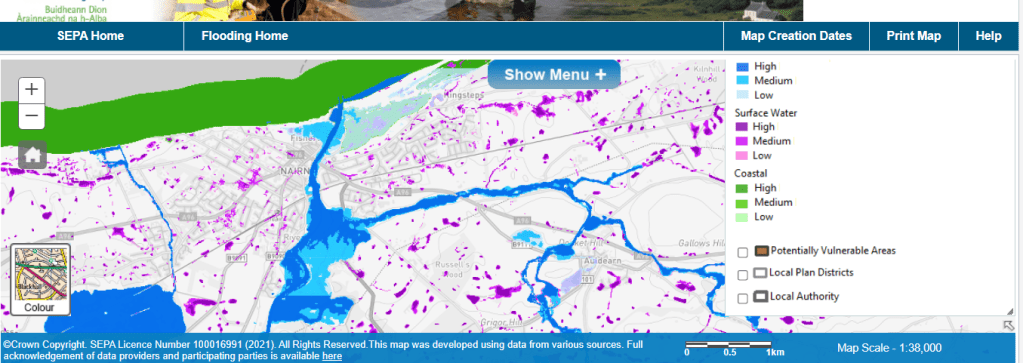
You can also visit the SEPA flood map to see detail of floodrisk where you live.
A ‘snapshot’ of this map is at top of page. (click on link above to search the online map)
A copy of the letter to sent to members of Highland Council’s Nairnshire Committee and the Chair of the Nairnshire Community Planning Partnership by the two Nairn CCs follows
Joint letter from Nairn West &Suburban Community Council
and Nairn River Community Council
Cllr Tom Heggie
Nairnshire Area Committee Chair
The Courthouse
High Street
Nairn (sent by email) 25th July 2021
FLOOD PREVENTION MEASURES IN THE NAIRN AREA
We are sure you and your colleagues will – like all of us – have observed with concern and alarm the recent media coverage of the disastrous floods in Germany, Belgium and Holland which have caused extensive damage and the tragic loss of many lives.
This is just the latest reminder of the risks posed by serious flooding. Edinburgh and areas along Deeside have also suffered floods recently, and in past years many other parts of the UK from Yorkshire to South West England have experienced similar problems. Climate change is undoubtedly causing more extreme weather. But local geography, the capacity of rivers and drainage systems, and the adequacy of protection measures are also contributory factors.
We in Nairn are not immune. Heavy rainfall and river spates, coinciding with high tides in the Firth, have in past years led to serious flooding in the Fishertown area and elsewhere. This has been exacerbated by CSO overflows and capacity problems with the (largely Victorian) town drainage network. We should not need the news from Germany and elsewhere as a reminder that the town is vulnerable.
In fact the need for effective prevention measures in the local area has long been recognised. As far back as 2012 SEPA produced an overall strategy which set out the timeline for completion of studies, preparation of plans and final publication by 2016. In 2015 SEPA issued a further strategy document. This identified the risks and impacts of flooding for each potentially vulnerable area (PVA). In the case of Nairn, there are three such areas. Two are the responsibility of Highland Council, and one comes under Moray Council’s plan but lists Highland Council as the lead authority.
In January 2020, prompted by the overflows along the Alton Burn, NW&SCC wrote formally to raise residents’ concerns both about that specific problem and about the implementation of wider flood prevention measures (copy of letter attached). The reply from a Highland Council official identified “… minor blockages in the Alton Burn but ….insufficient to cause backing up of flow…”. On the wider task of flood prevention the reply acknowledged that nothing had been done but that there was “the intention to progress”. At that time, no action had been taken in the Nairn West & Ardersier PVA and nothing was expected until 2022-28. The study for Nairn Central PVA (second highest priority in the whole Highland region) due in 2019, had not yet been done. Funding had been deferred to 2021-24, and it would “likely take a couple of years” after that even to reach an options appraisal report. Work on the Nairn East PVA was linked to this and so had similarly been put back.
In reviewing the current state of planning, we have noted that the subject of flood risk management (FRM) plans was discussed at the Council’s Economy & Infrastructure Committee on 4 February. The relevant report envisaged publication of a checklist of proposed “FRM Actions” by 21 March 2021 and public consultation on a draft Local FRM Plan by 21 June, to be followed by an appraisal.
We are not aware of any recently published list of Actions, invitation to comment, or draft plan for public consultation in the past six months; and we cannot recall any public statement or comment by local elected Members on the subject. The actions outlined appear to be the same as already identified in previous strategies and plans. Apart from the maintenance of the existing SEPA flood warning alert scheme, these involve – in the case of the Nairn PVAs – the preparation of studies, fluvial modelling, and selection of mitigation options.
A year and a half on from our previous representations, this work has still not begun. Now the timetable appears to have been further delayed. Even more worrying, the latest report warns that unless money is already allocated in the Capital Plan, there is no funding available and it will have to be sought in the form of a Scottish Government grant “on a prioritisation basis” (ie a competitive bidding process).
So in summary, action proposed in 2012 has slipped by more than a decade. Given the time required for studies, option appraisals, and selection of suitable mitigation measures, this suggests that no practical flood-prevention measures in respect of the Nairn PVAs appear now to be in prospect until perhaps 2025 or later. And there is a serious question-mark over the availability of funding, now and in the future.
This is not an encouraging picture; indeed it gives rise to serious concern. There is no doubt that Nairn is acutely vulnerable to further flooding. It is not a matter of “if” but “when”. Waiting until a further flood actually happens before taking action is not an acceptable approach.
It will not have escaped people’s notice that – by contrast – major flood prevention works along the River Ness have been completed and delivered over the past couple of years. Those who travel east will also have noticed the massive flood protection-schemes, also now complete, on this side of Forres and up the Mosset Burn; and along the Lossie and on the far side of Elgin.
As well as the physical measures that are clearly required, it is of course part of an effective strategy to have local resilience-planning in place and up to date as well. This necessarily involves not only the public agencies such as the police, fire and rescue, and health and social services, but also community organisations and volunteers.
As the Covid pandemic has shown, when the need arises local communities do respond. This underlines the case for the Community Councils and other relevant local organisations to be fully involved in the Community Planning Partnership and in other suitable local groupings (such as a revived Ward Forum, for example). This would provide a framework for discussion of priorities and for collaboration. Such local discussion can complement, but is not an alternative to, early action by those tasked to lead on the flood prevention strategy.
This letter is therefore a reminder and warning that urgent action is required in and for the Nairn PVAs by the agencies responsible for implementing the agreed plans. To quote the text on the very first page of the Highland Council’s own Flood Management Plan:
“The task now for us – local authorities, Scottish Water, the Scottish Environment Protection Agency (SEPA), the Scottish Government and all other responsible authorities and public bodies – is to turn our plan into action.”
That was written in 2016. It was supposedly an update and a commitment to deliver on a flood-prevention strategy drawn up in 2012. We are now well into 2021.
Further interim reports and explanations are not what is required. We now ask that the Council as the lead authority live up to that commitment and give appropriate priority and funding to the delivery “on the ground” of urgent flood-prevention measures for the Nairn area. We look forward to confirmation that this will be done, with clear timelines for completion.
This letter reflects the jointly-agreed views of both Nairn Community Councils. Copies go to the Chair of Auldearn CC (whose area is potentially also at risk), to your elected Councillor colleagues, Chair Nairn & Nairnshire Community Partnership and to the Ward Manager.
On 16th July the two Nairn community councils and Nairn Access Panel received initial designs from Highland Council for a proposed ‘active travel’ foot/cycle bridge to link Lochloy across the railway to Balmakeith Industrial Estate. Highland Council then posted on social media on 22 July a deadline for public comments of 30 July.
Due to the volume of email from concerned local residents our Chair organised an emergency community meeting for Lochloy residents and community councillors to meet online on 28th July with relevant THC officers and Highland councillors. This was not an official NRCC meeting as there was no time to give required 7 days public notice.
As a result of this meeting, in early August, local residents, with support from community councillors, circulated a survey to 1000 homes in Lochloy, Merryton and Kingsteps about the rail crossing proposal. Survey results were compiled and sent to Highland Council before the deadline for public consultation of 27th August which was extended from 30th July in response to a request by Nairn River CC Chairman Hamish Bain.
On 9th August 2021 a Special public meeting of NRCC was convened to formally agree our position on the current proposal for Lochloy bridge in this location. It was unanimously rejected by community councillors present as unsuitable.
PRIMARY ANALYSIS OF LOCHLOY COMMUNITY QUESTIONNAIRE
Survey conducted from 2nd – 23rd August 2021
No of questionnaires delivered 1000+ to homes at Lochloy, Kingsteps, Merryton
No of questionnaires returned 234 – 23.4%
64 (27.4%) supported the proposal
170 (72.6%) DID NOT support the proposal
158 (67.5%) DID NOT consider the proposal was safe for children
54 of the 64 households who supported the proposals considered them safe for children.
Number who responded as being disabled – 29 (12.6%)
Number who supported another road access/exit onto the A96 – 194 (83%) and commented this was the priority for the area.
Drill down analysis – usage and purpose of a bridgeto Balmakeith
Of those 64 households who supported the current proposals
17 (26.5%) would use it daily
36 (56.3%) would use it weekly
4 (6.3%) would use it monthly
7 ( 10.9%) less often
53 (82.9%) would use it to access the retail park (not for work)
7 (10.9%) would use it to access a place of work
4 (6.3%) other – walking, cycling or getting to a main bus stop.
Drill down analysis – Community Facilities
Four main suggestions emerged.
83 (36.1%) Local shop/convenience store
49 (21.3%) primary school
32 (13.9%) Post box
15 (6.5%) church/community hall
Other suggested community facilities included – GP surgery and clinics, Dentist, chemist, pub, restaurant, tennis courts, skateboard park, gym equipment
Thanks to all NRCC members who helped coordinate this, and the people of Lochloy, Merryton and Kingsteps who assisted with distribution of the surveys and took the trouble to fill them in and return them to us.
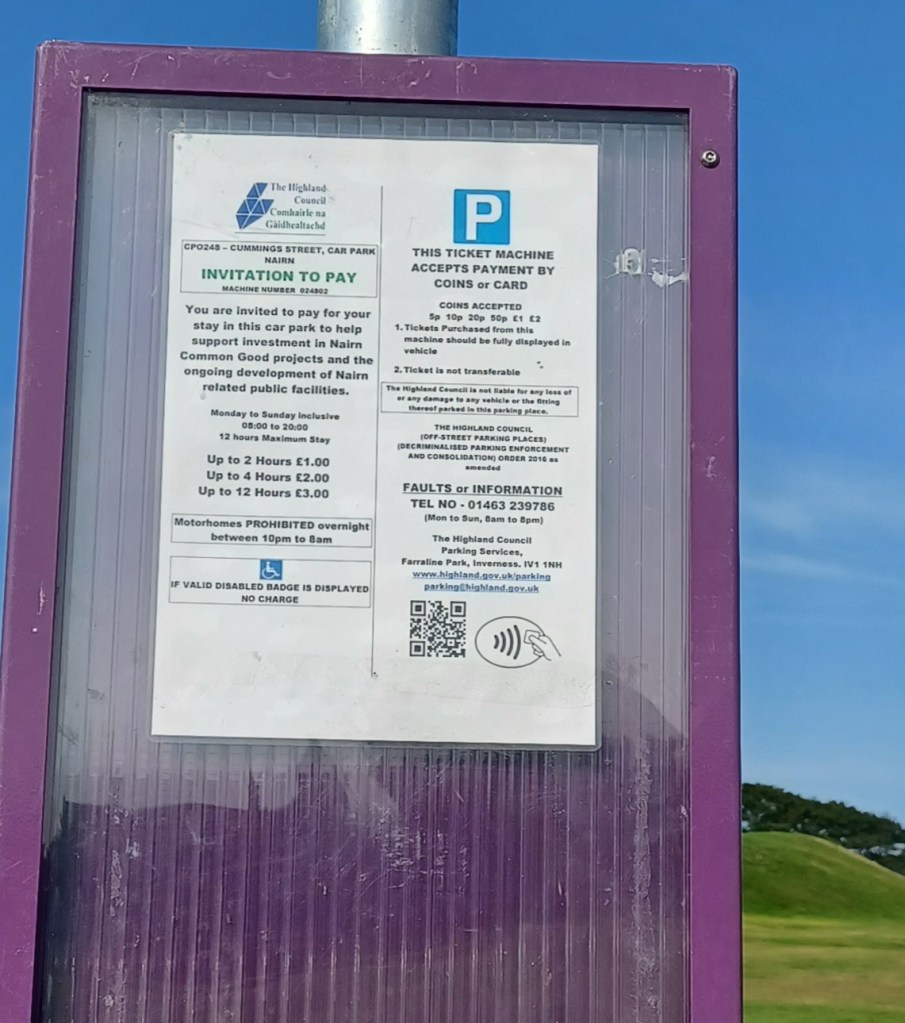
In Spring 2021 Nairn River Community Council were surprised to notice parking charges machines being installed at 3 car parks at the Harbour, the Links and the Maggot.
We were surprised because there has been no consultation with either of Nairn’s ‘town’ community councils or local residents about this, which must happen by law before any changes can be made to Nairn Common Good Assets.
Even without these legal requirements, the land where these car parks are is located in Nairn River Community Council’s territory, so as a matter of courtesy and transparency we would have expected Nairn’s Highland Councillors to have briefed us in advance that they were considering this action, before they approved it, and taken account of community views as part of their role as local elected representatives.
In 2020 a consultation on a new Parking policy for Highland, delayed from 2018, when Nairn community and business groups universally rejected charges for Nairn, was put ‘on hold’ again due to COVID lockdown.
In late summer 2020 representatives of Nairn River CC, West and Suburban CC, Nairn BID, and NICE (Nairn’s Community Development Trust) attended two meetings with Highland Councillors and Officers where Nairn’s ‘visitor management’ needs for 2021 were discussed.
We were assured that more information on public funding sources to improve toilets, camper van facilities and other visitor welcome resources would be shared by Highland Council with all parties present for further community discussion before anything would be taken forward.
It was also agreed (or so we thought) that full public consultation would take place before any decision would be taken on charging for Common Good land car parks.
Many residents agreed that improved public toilets, camper van facilities and a better visitor welcome were urgently needed for Nairn. However, as in 2018, most locals did not want to pay for parking, particularly on the Links, and did not see this as a suitable source of funding for improvements mentioned above, when significant Visitor Management funding was being invested by Highland Council in other Highland towns to provide public toilets and other facilities.
Local residents also pointed out that imposing charges around the seafront would add congestion to Fishertown’s narrow streets where parking is already in short supply.
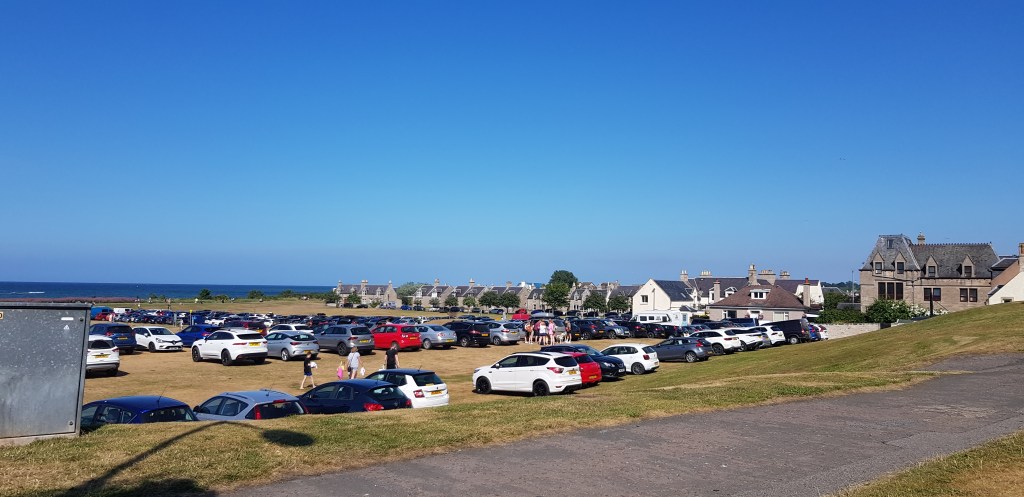
Links Parking Summer 2021
This has come to pass this summer, along with more cars routinely parking on grass at the Links than ever before, causing significant local concerns about long term environmental damage, and detrimental effects on use of these ‘green spaces’ for ‘recreation’ such as football and cricket, their original purpose when they were gifted to the town for the Common Good of the people of the Burgh.
We have read about local shops and businesses suffering in towns like Forfar and Montrose because parking charges were imposed by the local Angus Council in 2018 without proper community consultation or consideration of negative impacts.
Actual revenue raised by this ill fated and damaging scheme also turned out to be less than half of Angus Council’s projections.
Parking in Angus is now free as charges have been suspended completely till at least 2022. The Nairn situation is also more complex due to car parks being on Common Good land.
Why doesn’t Highland Council learn from this and carry out proper ‘impact assessments’ so that a transparent and financially viable business case can be presented to the public before implementation, to demonstrate that all local ‘costs’ (social and environmental as well as economic) are factored in and do not outweigh benefits?
In Nairn this summer we have had ‘voluntary’ charges on the Links, Maggot and Harbour Car Parks since June, and thanks to good weather and a boom in UK tourists on ‘staycation’ and daytrippers to Nairn beach, Shane Manning Highland Council’s Parking Service Manager has been posting regularly on local Facebook pages that charging in Nairn is paying well.
However no detailed financial business case or income projections for this ‘pilot project’ have been made available to the public to provide a context for Shane’s Facebook posts. We do not know how much public money has already been spent to set up ‘charging infrastructure’, or what it will cost to run and enforce a charging scheme in the longer term all year round. Most importantly we have no idea how much income, if any, will be left for our Common Good Fund once Highland Council’s various costs are covered, and we are told that THC are to take half the profit too.
What we do know is that in April 2021, Nairn’s four Highland Councillors, who are also ‘Common Good Trustees’ for Nairn, agreed at the Nairnshire Local Area Committee for ‘charging infrastructure’ to be installed and activated from June.
This reports that the charging scheme was given the go ahead, in spite of Councillors querying the ‘legality’ of Highland Council splitting the ‘profits’ from Nairn parking charges 50/50 with Nairn Common Good fund. There is no record of any Councillor/Common Good Trustee present querying the lack of prior public consultation on this Common Good matter.
Our understanding of the 2015 Community Empowerment Act is that 100% of net revenue raised from Common Good Assets must return to that Common Good fund. This means that it would be illegal for Highland Council to profit from use of this land.
We have been told that there will be consultation in the autumn, after this charging scheme has been running for several months.
This is entirely at odds with the principle of ‘prior’ consultation as laid down in the Community Empowerment Act 2015, which is supposed to make sure that a local authority takes time to present options to the public, assess local impacts and seek approval of the local community, before decisions are taken to make any change to the use of Common Good Land.
Instead Highland Council has already invested significant public funds in charging infrastructure which clearly they plan to use, without consulting the public.
To clarify this unsatisfactory situation Nairn River Community Council decided in June 2021 to ask the following questions of Highland Council Officers and elected Councillors.
20 Questions for Nairn Councillors, Shane Manning Parking Manager, and Sara Murdoch Common Good Manager Highland Council
From Nairn River Community Council on behalf of the local community
Context
Councillor Heggie requested some ‘focussed questions’ at NRCC meeting on 16th June when Common Good parking charges were discussed and diverse concerns were raised by community councillors and public present.
There are 20 questions here. We expect that the people of Nairn will have more questions of their own about why they have been ‘bypassed’ in this manner.
The legality of this decision by Councillors at Nairnshire Area Committee 20th April 2021.
Q1 Why have Nairn Councillors made a decision with such significant implications for Nairn Common Good assets without first verifying the legality of what is proposed?
Q2 Why have Nairn Councillors ignored their ‘Common Good Trustee’ legal responsibilities by taking a decision affecting Common Good Assets without any prior public consultation?
Q3 Can you provide details of any other parking scheme on Common Good Land where less than 100% of net revenue is returned to the local Common Good Fund
Q4 Will Nairn(shire) residents (who already pay Council Tax to Highland Council) be exempt from paying parking charges on Common Good Land which was gifted to the town for their sole benefit?
The use of Common Good Land is of concern to all the people of Nairn.
To ‘suggest’ that Community Councils are informed after the charging scheme is operational, and infrastructure has been installed on the site, as this minute notes, is in clear breach of Community Empowerment legislation.
Engaging with community councils is not a ‘suggestion’. It is a legal requirement.
Transparency and the requirement for public consultation
Q5 Who decided to adopt a ‘policy’ of non engagement with the local community until after this parking scheme was operational?
Q6 Who decided to ‘delegate’ public engagement on this matter to Shane Manning the Parking Manager, rather than Councillors or the Common Good Officer communicating directly with Community Councils.
Q7 Please confirm what arrangements are in place to give the community a full say in all future decisions on how this charging scheme operates and how income is used if it goes forward
Q8 Why has there also been no prior public consultation on how Scottish Government ‘visitor management’ funds were to be invested in Nairn? ‘Charging infrastructure’ was certainly not the only option with local public toilets in disrepair.
Q9 If the Nairn Community vote to remove parking charges in future, who will remove the equipment and who will pay for this?
Q10 Why are HC already proposing ways to spend revenue from parking charges on CG land not yet consulted upon by the local community, never mind agreed?
If the community agree to parking charges on their land, it is for them to decide how the money is used. CCTV may benefit THC but may not be what local people want.
Q11 Will Nairn Community Councils from now on receive regular written reports on income and usage data along with comparative data from other Highland sites?
We are particularly keen to see detail of the ‘£1Million raised for Portree’ mentioned by Shane Manning at a recent NWSCC meeting.
Q12 Please provide full detail of how this ‘pilot scheme’ is being monitored, what defines ‘effectiveness’ and what data will be shared routinely as part of proactive information sharing with Community Councils (as mentioned in the minute above)
We note inconsistencies in income figures quoted so far in public (on social media and at recent CC meeting). Shane Manning has stated that a single day’s income of £1252 represented a 40% uptake of paid parking. Then he reported that the total income for the first 5 weeks was £5300 for all 3 car parks which is closer to 7%.
That represents £25 income per car park per day for Nairn Common Good as a 50% share of total revenue, and will likely drop once summer is over. This does not sound like ‘best value’ for either HC or Nairn CG if initial outlay on infrastructure to implement charging has already cost around £75000. (according to Cllr Saggers)
The ‘business case’ and financial arrangements for this ‘pilot’
Q13 Please confirm actual costs of charging set up and implementation to date.
Q 14 Please provide full detail to Community Councils and the public of the 50/50 ‘split’ of revenue between THC and Nairn Common Good which was agreed to by Nairn’s Councillors on 20 April for these 3 car parks.
Q15 As previously requested in 2018, for public transparency, please supply a full ‘business case’ for proposed parking charges with cash flow projections to show that net income would provide a surplus for Nairn Common Good once all set up and running costs are factored in. Please also specify which running costs are to be paid for by THC and which by Nairn Common Good going forward.
Q16 Please provide evidence of other car parks in Highland where Rates are being paid for routinely by the Council, as suggested here.
Q17 Please provide detail of how revenue and usage projections for Nairn prepared for this current pilot compare with actual spend and car park income so far.
Q18 If grassed areas of Common Good land at the Links are to be fenced off with barriers to limit parking, and may need to be removed and replaced for Games Day and the Showies, can you confirm whether these extra costs will fall to the Nairn Common Good Fund or the Council
Motorhome facilities
Q19 What plans are in place for signage to direct visitors with motorhomes from the seafront and Nairn Town Centre to appropriate private facilities at Parkdean and out of town
Q20 Will Highland Council have to compensate Parkdean( Caravan Site) who already pay rent for Nairn Common Good Land, for loss of motorhome income if HC is proposing to provide a rival facility at the Maggot?
Responses from Highland Council to Nairn River’s 20 questions
Nairn River CC Chair received the following response on 22nd July from Emma Tayler the interim Ward Manager for Nairn.
Note that the response to question 6 that ‘ Shane(Manning, Highland’s Parking Services manager) attended the NWSCC online meeting to brief and answer any questions (3 hours), but despite the offer being made, no similar invite from NRCC has been received. ‘ is misleading. In fact several Nairn River CC members sat in on the above mentioned ‘Westies’ CC meeting and listened to Shane Manning- but were not satisfied that the Parking Service Manager provided sufficient detail about financial arrangements for the current pilot and he made clear that Common Good matters were outside his area of expertise, so we decided to send written questions to Highland Council as detailed above. Nairn River CC had only one remaining public meeting scheduled in June before the summer break – our AGM – and we were not able to accommodate Shane on that Agenda.
One of our members did ask Shane Manning directly via Facebook, to share a detailed ‘business case’ for this pilot with Nairn River CC and the public, but he has not done so.
We plan to continue dialogue on this matter and look forward to participating in the promised public consultation process on the current pilot parking charges scheme.
Letter received from Emma Tayler Ward Manager 22nd July 2021 (NRCC questions in italics)
Dear Mr Bain
Thank you for your enquiry. Please find outlined responses to your questions below. I trust this is helpful in clarifying the points that you make.
I do think it is important to highlight that there seems to be a misunderstanding underpinning a number of these questions. To be clear, what has been introduced in Nairn, for the 2021 summer season only, is a voluntary charging scheme. People are invited to pay for parking and there is no enforcement of parking charges.
As noted in the agenda note to the Nairnshire Committee where the voluntary scheme was agreed, a consultation will take place later in 2021 to determine the approach going forward. This would consider whether a voluntary scheme of charging is continued, charging with enforcement is introduced or whether no changing is introduced. This is in line with the Council’s car parking policy agreed in October 2019 and in line with Community Empowerment legislation in relation to change of use for Common Good assets.
As offered previously, the Parking Services Manager – Shane Manning – is very happy to attend a meeting of Nairn River Community Council, as he has already done for Nairn West and Suburban Community Council.
Your sincerely
Emma Tayler
Acting Ward Manager
Ward 18 – Nairn & Cawdor
Q1 Why have Nairn Councillors made a decision with such significant implications for Nairn Common Good assets without first verifying the legality of what is proposed?
The validity of the Invitation to pay (ITP) was discussed with the Common Good Officer who was content that as the charges are voluntary and lie within current regulations regarding regulation of Off-Street Car Parks, this was not a material change in circumstances.
Q2 Why have Nairn Councillors ignored their ‘Common Good Trustee’ legal responsibilities by taking a decision affecting Common Good Assets without any prior public consultation?
The Community Empowerment Act provides the circumstances when consultations must be undertaken. The current voluntary payment scheme does not constitute a disposal or a change of use, therefore does not trigger the requirement to consult.
Q3 Can you provide details of any other parking scheme on Common Good Land where less than 100% of net revenue is returned to the local Common Good Fund
There is a longstanding arrangement for use of the Town House car park in Inverness where a “rental” payment is made for use and any income earned above that by charging is retained by the operating service.
Q4 Will Nairn(shire) residents (who already pay Council Tax to Highland Council) be exempt from paying parking charges on Common Good Land which was gifted to the town for their sole benefit?
The history of Common Good in brief terms is that the land that came with the Charter was to be used for advancing the prosperity of the Burgh with any revenue received being used for the “common good” of the Burgh. When the Burghs were abolished in 1975 ownership passed to the District and Island Councils under the provision that such property was to be administered having regard to the interests of the inhabitants of the former Burgh. This provision was further confirmed in the subsequent reorganisation under the Local Government etc. (Scotland) Act 1994.
The fact the car parks are on Common Good land does not automatically mean residents should continue to park for nothing. If anything, making use of such Common Good land to raise revenue is, in itself, an example of administering such property in the interests of the inhabitants.
Please note, as highlighted above, residents still do not currently have to pay for parking as the current scheme is voluntary. However, there is nothing to prevent such a scheme being introduced on Common Good land subject to the appropriate consultation processes being undertaken.
The use of Common Good Land is of concern to all the people of Nairn. To ‘suggest’ that Community Councils are informed after the charging scheme is operational, and infrastructure has been installed on the site, as this minute notes, is in clear breach of Community Empowerment legislation.
Engaging with community councils is not a ‘suggestion’. It is a legal requirement.
The Community Empowerment Act provides the circumstances when consultations – including with Community Councils – must be undertaken. However, as noted above, the current voluntary payment scheme does not constitute a disposal or a change of use, therefore does not trigger the requirement to consult. There has therefore been no breach of Community Empowerment legislation.
As noted in the agenda note to the Nairnshire Committee where the voluntary scheme was agreed, a consultation will take place later in 2021 to determine the approach going forward. This would consider whether a voluntary scheme of charging is continued, charging with enforcement is introduced or whether no changing is introduced.
Transparency and the requirement for public consultation
Q5 Who decided to adopt a ‘policy’ of non-engagement with the local community until after this parking scheme was operational?
See above
Q6 Who decided to ‘delegate’ public engagement on this matter to Shane Manning the Parking Manager, rather than Councillors or the Common Good Officer communicating directly with Community Councils.
Shane Manning is the responsible officer for the service delivering the scheme. Shane therefore has the expertise and the knowledge to engage on this issue. Shane attended the NWSCC online meeting to brief and answer any questions (3 hours), but despite the offer being made, no similar invite from NRCC has been received. Furthermore, sharing information online helps to increase transparency with the whole community.
Q7 Please confirm what arrangements are in place to give the community a full say in all future decisions on how this charging scheme operates and how income is used if it goes forward.
As noted above, a consultation will take place later in 2021 to determine the approach going forward. This would consider whether a voluntary scheme of charging is continued, charging with enforcement is introduced or whether no changing is introduced. This is in line with the Council’s car parking policy agreed in October 2019 and in line with Community Empowerment legislation in relation to change of use for Common Good assets. This will be the opportunity for the community to have a say on potential charging.
Q8 Why has there also been no prior public consultation on how Scottish Government ‘visitor management’ funds were to be invested in Nairn? ‘Charging infrastructure’ was certainly not the only option with local public toilets in disrepair.
None of the money has come from Scottish Government Visitor Management Funds. Installation of meters has been funded by The Highland Council Visitor Management funds allocated for 2021 (£1.5m across services – £250k Parking).
Q9 If the Nairn Community vote to remove parking charges in future, who will remove the equipment and who will pay for this?
If, following any consultation, a decision is taken not to introduce charging on an enforcement basis or not to continue with a voluntary scheme for charging, the removal of the meters will be undertaken at the Council’s expense.
Q10 Why are HC already proposing ways to spend revenue from parking charges on CG land not yet consulted upon by the local community, never mind agreed?
The 50/50 split has been agreed by Members as part of the process agreed in October 2019. This applies to the voluntary scheme too.
Any income received would form part of the Common Good fund for Nairn and administered as such.
If the community agree to parking charges on their land, it is for them to decide how the money is used. CCTV may benefit THC but may not be what local people want.
This is a misunderstanding of the administration and management of Common Good Funds. Any decisions on use of Common Good funds will be made in accordance with Council governance policies and procedure. These are funds raised by use of Common Good assets held by the Council and the financial responsibility sits with the Council as custodians of the Common Good.
Q11 Will Nairn Community Councils from now on receive regular written reports on income and usage data along with comparative data from other Highland sites?
No. Reports on income and usage will form part of Common Good monitoring reports to the Nairn and Nairnshire committee which is responsible for the governance and administration of the Nairn Common Good Fund.
We are particularly keen to see detail of the ‘£1Million raised for Portree’ mentioned by Shane Manning at a recent NWSCC meeting.
At the NWSCC we described the match funding THC were able to deliver on the basis of income raised being used to leverage capital borrowing in Portree – namely Bayfield Car Park Circa £700k project (£290k Capital allocated based on future Parking Income) – Storr Roadside (£75k Capital Borrowed based on future Parking Income), Storr Car Park (Circa £400k project with some Capital allocated based on Future Parking Income) – 2 pedestrian Crossings installed in Portree (£70k – funded from future Parking Income.).
Q12 Please provide full detail of how this ‘pilot scheme’ is being monitored, what defines ‘effectiveness’ and what data will be shared routinely as part of proactive information sharing with Community Councils (as mentioned in the minute above)
This will be reported to Members and to the general public online through reports to the Nairn and Nairnshire Area Committee to ensure transparency.
We note inconsistencies in income figures quoted so far in public (on social media and at recent CC meeting). Shane Manning has stated that a single day’s income of £1252 represented a 40% uptake of paid parking. Then he reported that the total income for the first 5 weeks was £5300 for all 3 car parks which is closer to 7%.
That represents £25 income per car park per day for Nairn Common Good as a 50% share of total revenue and will likely drop once summer is over. This does not sound like ‘best value’ for either HC or Nairn CG if initial outlay on infrastructure to implement charging has already cost around £75000. (according to Cllr Saggers)
At the NWSCC one day’s income for Cumming Street was analysed and discussed. This showed that the available amount of time for sale and the actual time sold via the Ticket Machines equated to 40%.
There were no inconsistencies in the income figures quoted. What is quoted above is a misunderstanding of data relayed to the CC in the meeting:
24th May to 31st May – 8 days
177 spaces available for “sale” across 3 sites
Bank Holiday Monday 31st May
Cumming Street
2124 hours per day available
845 hours purchased (31/5/21) 40%
First 8 days across 3 Car Parks
873 individual transactions
£1252 income
The service has invested £27,000 (Ticket machines, civils and signage) to date.
The ‘business case’ and financial arrangements for this ‘pilot’
Q13 Please confirm actual costs of charging set up and implementation to date.
£27000: Ticket Issuing Machines, installation costs and signing and lining.
Q 14 Please provide full detail to Community Councils and the public of the 50/50 ‘split’ of revenue between THC and Nairn Common Good which was agreed to by Nairn’s Councillors on 20 April for these 3 car parks.
All income after VAT payments – (50% Gross to CGF – 50% remaining split 20% running costs, 30% service)
INCOME collected to date 24th May to 12th July 2021
7 calendar weeks – 6938 transactions
£9646.50 Gross Income
£8038.75 after VAT
Q15 As previously requested in 2018, for public transparency, please supply a full ‘business case’ for proposed parking charges with cash flow projections to show that net income would provide a surplus for Nairn Common Good once all set up and running costs are factored in. Please also specify which running costs are to be paid for by THC and which by Nairn Common Good going forward.
2018 relates to the introduction of the Parking Management Policy and a proposal to impose enforceable parking charges, which was further amended in 2019 – This scheme was paused due to Covid 19 as statutory consultations were very difficult to deliver.
Current general Car Park operational costs funded by service and not charged back to CGF to date.
1. Rateable Value – £100 per bay
2. Water Rates – £120 per year per Car Park
3. Average Annualised Service cost over 40-year lifespan of a Car Park – Surfacing, lining, signage, lighting, waste & amenity costs. £53 per bay per year
2021 ITP scheme costs
4. Ticket Machines £4500 each (6No.) – Running cost – £400 per year per machine
5. Manpower funded by service
6. Cash collection and admin funded by service
Q16 Please provide evidence of other car parks in Highland where Rates are being paid for routinely by the Council, as suggested here.
Rates paid 2018/2019
B&S
Caith
Inv
Loch
Nairn
R&C
Skye
Suth
Total
Water Rates
557
498
14,895
1,696
357
10,707
781
258
£29,749
Business Rates
9,576
12,144
159,412
66,528
13,152
53,832
17,472
17,112
£349,228
Q17 Please provide detail of how revenue and usage projections for Nairn prepared for this current pilot compare with actual spend and car park income so far.
The base calculation for car park income is £417 (after VAT) per bay per year. Calculated from average income per bay achieved at all existing car parks.
There are 177 bays across the 3 car parks.
Potential income based on enforceable parking charges on £417 per pay per annum £73,809 per annum
Income to date £8038.75 for 7 weeks if extrapolated to 12 months 52 weeks = £59716.43
This figure would need to be reduced to reflect seasonal variation.
Q18 If grassed areas of Common Good land at the Links are to be fenced off with barriers to limit parking, and may need to be removed and replaced for Games Day and the Showies, can you confirm whether these extra costs will fall to the Nairn Common Good Fund or the Council
This has not been discussed.
Motorhome facilities
Q19 What plans are in place for signage to direct visitors with motorhomes from the seafront and Nairn Town Centre to appropriate private facilities at Parkdean and out of town
Signs have been ordered to inform drivers of availability of Parking at East beach. No scheme to signpost camping facilities as yet.
Q20 Will Highland Council have to compensate Parkdean who already pay rent for Nairn Common Good Land, for loss of motorhome income if HC is proposing to provide a rival facility at the Maggot?
No. It is widely understood that many campervans do not wish to park in designated camping sites and that even those who may wish to, are unable to because there is no capacity. The Council’s Tourism Committee has agreed to allow the option for motorhomes to stay in Council car parks for a maximum 24hrs, all activity to be contained within vehicle and prices range from £5 to £10 dependent on facilities made available. This is to support management of the current challenge and issue of campervan parking across the Highlands.
The potential use of the Maggot is a suggestion only at this stage – utilising any of the grassed area would require preparation of a proposal which could form the basis of a Common Good consultation as it would be a change of use. A court application for authority would also be required as the Maggot is considered to be inalienable land.
Nairn River Community Council are pleased to welcome you to our new website.
It is still a work in progress – so bear with us!
We welcome your feedback if there is any information you would like to see here to keep local residents informed and involved in local development and service planning.
We are pleased to say that, after a difficult period of internal strife we are now back to focussing 100% on serving Nairn River residents as a unified community council.
We have just coopted two new community councillors with great experience and skills, and since our June AGM our volunteers have spent a busy summer, supporting residents with a survey of Lochloy, Merryton and Kingsteps about the proposed Lochloy active travel crossing, keeping tabs on ‘voluntary’ parking charges at the Links and other Common Good car parks and getting this website ready for you.
If you would like to become a community councillor, we have a number of vacancies to fill for adults and two under 18 members. Why not come along to our public meetings and learn more about what we do and the structures within which we operate as a public body.
We are looking for energetic and enthusiastic volunteers willing to put personal interests aside, and work reliably with others for this community as part of a team. Initial training will be provided and you will need to do some background reading between meetings to keep up with the wide range of public policy matters which come our way, so that you can make fully informed decisions as a community councillor. You should be able to engage respectfully with colleagues and the wider community and listen impartially to diverse views and opinions of local residents, observing confidentiality as required.
You may also be required to represent the community council at meetings and in other public settings and be able to accurately summarise and communicate information about local matters to others, both in writing and face to face.
If you’d like to put your name forward as a community councillor – please contact us.
Also get in touch if you have any concerns or questions about issues affecting your neighbourhood which you would like us to help resolve with Highland Council or other public authorities who provide services and make decisions for Nairn.




 Nairn River Community Council